Perhaps not unlike many children my age, I first came to know Edinburgh through Harry Potter: the legendary place where J.K. Rowling had first dreamed up the boy wizard. Once, a visit to The Elephant House, where the story’s first chapters were written, would have been one of the highest pilgrimages I could make in the United Kingdom. And rightfully so, I think. I owe a great deal to Rowling. Her stories taught me, as they did many in my generation, about the power of our choices, even when our actions seem to have little effect on the wider picture. They offered me role models, particularly in the form of a bookish girl who could get along just fine with her classmates without sacrificing her grades. And it was thanks to Rowling, more so than anyone except perhaps my third-grade teacher, that I learned how to write. She told her readers that if they wanted to learn to write, they had to read: to read everything that came in front of them, from the nutrition facts on the cereal box to any book that passed into their hands.
Continue reading “City of Literature”Tag: world war I
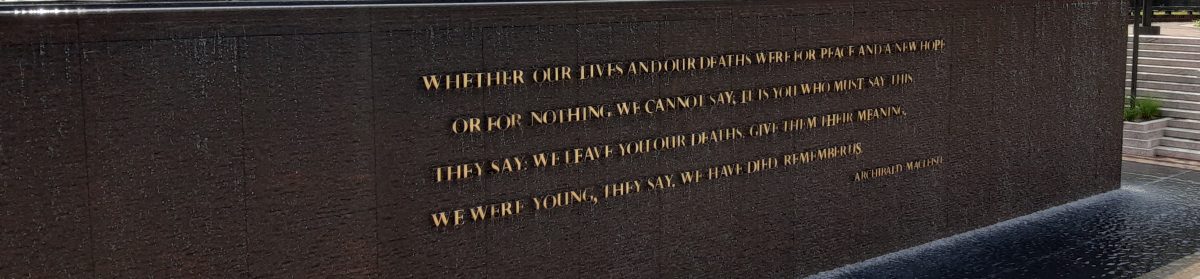
Lest We Forget
This September, on a flight from Seattle to Chicago, I met a man who lived in Michigan and was flying home to surprise his wife. Flights into O’Hare, for anyone who has not had the unique misery of heading there themselves, often land early and then sit stranded out on the runway for half an hour. This one took a full hour, and he grew increasingly worried that he wouldn’t make his connecting flight to get home in time. I asked what he would do. “I’ll just rent a car and drive,” he told me. If he did that, he would still get there by the time she woke up.
I could make a statistical guess based on various demographic details about how he voted last Tuesday. I could probably make similar guesses about other strangers I have met in my endless trips around the country: about a retired Army colonel who lives in North Carolina and paid for me to go on a historical tour because he heard I was a student; about the man who stopped my father and me when we were out canvassing in Wisconsin a week ago to warn us that without a flashlight on, we risked getting hit by a car; about a group of women who took me out to lunch in rural Wyoming just because I had driven up to visit their town. I could, but I won’t, because I remember them as decent people, and because we must see our fellow Americans as human beings first, whatever they are to us second.
Continue reading “Lest We Forget”On Miracles
Hartsdale, New York is home to one of the country’s more eccentric pieces of history: the nation’s oldest, largest, and (in their own words) “most prestigious” pet cemetery. Founded in 1896 when a local doctor gave his friend permission to bury her beloved dog in his apple orchard, it is now the final resting place of thousands of animals, mostly dogs and cats.
I first learned about it as I searched the state for World War memorials: an early memorial in the cemetery, named the War Dog, is dedicated “by dog lovers to man’s most faithful friend, for the valiant services rendered in the World War, 1914 – 1918.” The staggering human cost of World War I often hides the toll it took on animals and on nature, but it too is nearly beyond imagining. After the war, veterans of the Great War estimated a soldier’s life expectancy on the Western Front to be three to six months. The life expectancy of a horse was two weeks.
Continue reading “On Miracles”Ironic Points of Light
Several months ago, I had a fascinating conversation with an archivist in New Ulm, Minnesota. I had gone out for the day to review some documents surrounding New Ulm’s World War history – a heavily German town, they had suffered intense discrimination during both World Wars, a story reflected in the town’s monuments. But what New Ulm is famous for in Minnesota history comes earlier: in 1862, the town was besieged as part of the US-Dakota War, a war waged by Dakota people against white settlers for their violation of land treaties. In the same year that the Battle of Antietam handed us the single bloodiest day of combat in US history, it is a war not often minded outside of Minnesota, but it is one that deeply marked the state’s history. The hanging of 38 Dakota prisoners as punishment for the insurrection remains the largest single-day mass execution in U.S. history, and the Dakota people were banished from the state. The attack on New Ulm, meanwhile, was commemorated in a painting that was hung in the Minnesota State Capitol in 1923. It remained for nearly one hundred years, until it was removed in 2016.
Continue reading “Ironic Points of Light”And They Shall Beat Their Swords into Plowshares
Being as I spend most of my time looking at World War I memorials, I sometimes forget that Veterans Day, for most Americans, is the kind of federal holiday where you have to stop and think about why the library is closed and you aren’t getting any mail. There are still ceremonies if you know where to look for them (usually, at the town war memorials); there are often articles about veterans in the daily newspapers; Google has made a Doodle about it, but it does not command the public attention it once did. In the interwar years, Americans gathered yearly in long parades and large public gatherings to honor the dead of World War I. They did this even though Armistice Day was not made a federal holiday until 1938. In 1954, the holiday was renamed Veterans Day, to honor veterans of all wars.
Continue reading “And They Shall Beat Their Swords into Plowshares”Abandoning the ‘War’ on COVID
When lilacs last in the dooryard bloom’d,
And the great star early droop’d in the western sky in the night,
I mourn’d, and yet shall mourn with ever-returning spring.
Sometime this month or next, the United States will hit a once-unimaginable milestone: one million dead from coronavirus. When that happens, the reaction from many will be muted. Americans are exhausted, most agree, and they are ready to put the pandemic behind them, whether or not the pandemic is done with them. We have hit so many milestones by now that these numbers appear almost meaningless to us. What makes one million more unimaginable than any of the rest of them?
Continue reading “Abandoning the ‘War’ on COVID” Much That Is Fair