Lest We Forget

This September, on a flight from Seattle to Chicago, I met a man who lived in Michigan and was flying home to surprise his wife. Flights into O’Hare, for anyone who has not had the unique misery of heading there themselves, often land early and then sit stranded out on the runway for half an hour. This one took a full hour, and he grew increasingly worried that he wouldn’t make his connecting flight to get home in time. I asked what he would do. “I’ll just rent a car and drive,” he told me. If he did that, he would still get there by the time she woke up.

I could make a statistical guess based on various demographic details about how he voted last Tuesday. I could probably make similar guesses about other strangers I have met in my endless trips around the country: about a retired Army colonel who lives in North Carolina and paid for me to go on a historical tour because he heard I was a student; about the man who stopped my father and me when we were out canvassing in Wisconsin a week ago to warn us that without a flashlight on, we risked getting hit by a car; about a group of women who took me out to lunch in rural Wyoming just because I had driven up to visit their town. I could, but I won’t, because I remember them as decent people, and because we must see our fellow Americans as human beings first, whatever they are to us second.

Continue reading “Lest We Forget”

In Search of a Usable Past

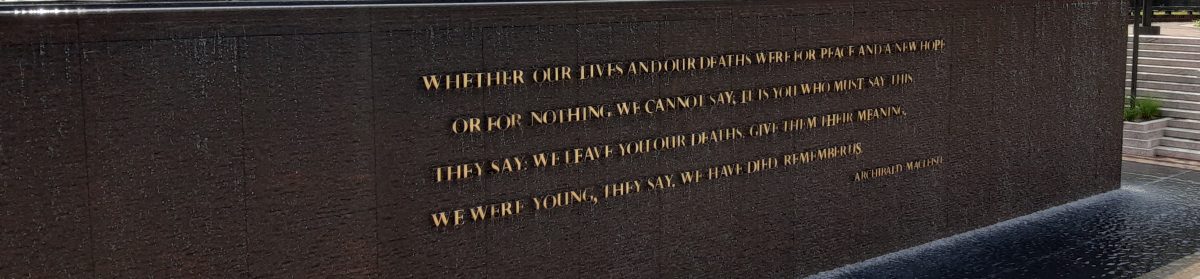
I have never bothered to conduct a survey, but I suspect that if you did, less than ten percent of the American population could reliably distinguish between the origins of Memorial Day and Veterans Day, rolled as they have been into one commemorative space. This is not your average American’s fault, really: maybe Memorial Day is a little more exciting, with the guaranteed three-day weekend and day off, but we have not marked them as distinct in any meaningful way for a long time now.

They are, however, quite distinct. Memorial Day is the older of the two, although it was once celebrated primarily on May 30, moving through the week like Veterans Day does. It was also reliably celebrated in only half the country until, at the very least, World War I, and in some places not until the 1990s. When it was known as Decoration Day, Memorial Day was a holiday to honor Union soldiers; states of the former Confederacy, in a rarely successful display of their commitment to states’ rights, selected different dates by state for Confederate Memorial Day. The death of Stonewall Jackson, May 10, was popular; so was the date of the Confederate surrender to William Tecumseh Sherman (April 26). Strangely, given their consummate fixation on defeat, no one selected April 9: the date of the surrender at Appomattox.

Continue reading “In Search of a Usable Past”

Je Me Souviens

One of the curses of being a graduate student is that you are completely unbound from the normal tethers that anchor people to reality, like working hours and HR offices and regular, reliable wages. It is a challenge that has both professional and personal ramifications – is well documented, these days, the kinds of abuses that graduate students are vulnerable in the academy, but it is quite possible to drive yourself mad in a world without deadlines, job prospects, or any clear sense of what you’re doing most of the time. To finish in one piece, you must find your own way of handling the constant uncertainty.

I have coped with this pressure, for better or worse, by leaning into it, which gives me the (mostly false) illusion that I have some control over what I’m doing and what will happen to me when I graduate. Most recently, this led me north, all the way to our Canadian neighbors, where I spent a brief period this winter visiting Quebec City and their Winter Carnaval while working on writing a dissertation chapter.

Continue reading “Je Me Souviens”

On Miracles

Hartsdale, New York is home to one of the country’s more eccentric pieces of history: the nation’s oldest, largest, and (in their own words) “most prestigious” pet cemetery. Founded in 1896 when a local doctor gave his friend permission to bury her beloved dog in his apple orchard, it is now the final resting place of thousands of animals, mostly dogs and cats.

I first learned about it as I searched the state for World War memorials: an early memorial in the cemetery, named the War Dog, is dedicated “by dog lovers to man’s most faithful friend, for the valiant services rendered in the World War, 1914 – 1918.” The staggering human cost of World War I often hides the toll it took on animals and on nature, but it too is nearly beyond imagining. After the war, veterans of the Great War estimated a soldier’s life expectancy on the Western Front to be three to six months. The life expectancy of a horse was two weeks.

Continue reading “On Miracles”

Lord, Have Mercy on This Land of Mine

I don’t know what most folks look for when they travel, but as a historian, one of the most interesting intersections to me in all of America is in Alabama: a circle called Court Square, at the center of downtown Montgomery. It is not a particularly commanding visual, and it holds some of the greatest horrors of the American past in its cobblestones. But as a relic of the layers of American history, all crowded into one tiny little space, it’s hard to beat.

Continue reading “Lord, Have Mercy on This Land of Mine”

Ironic Points of Light

Several months ago, I had a fascinating conversation with an archivist in New Ulm, Minnesota. I had gone out for the day to review some documents surrounding New Ulm’s World War history – a heavily German town, they had suffered intense discrimination during both World Wars, a story reflected in the town’s monuments. But what New Ulm is famous for in Minnesota history comes earlier: in 1862, the town was besieged as part of the US-Dakota War, a war waged by Dakota people against white settlers for their violation of land treaties. In the same year that the Battle of Antietam handed us the single bloodiest day of combat in US history, it is a war not often minded outside of Minnesota, but it is one that deeply marked the state’s history. The hanging of 38 Dakota prisoners as punishment for the insurrection remains the largest single-day mass execution in U.S. history, and the Dakota people were banished from the state. The attack on New Ulm, meanwhile, was commemorated in a painting that was hung in the Minnesota State Capitol in 1923. It remained for nearly one hundred years, until it was removed in 2016.

Continue reading “Ironic Points of Light”

And They Shall Beat Their Swords into Plowshares

Being as I spend most of my time looking at World War I memorials, I sometimes forget that Veterans Day, for most Americans, is the kind of federal holiday where you have to stop and think about why the library is closed and you aren’t getting any mail. There are still ceremonies if you know where to look for them (usually, at the town war memorials); there are often articles about veterans in the daily newspapers; Google has made a Doodle about it, but it does not command the public attention it once did. In the interwar years, Americans gathered yearly in long parades and large public gatherings to honor the dead of World War I. They did this even though Armistice Day was not made a federal holiday until 1938. In 1954, the holiday was renamed Veterans Day, to honor veterans of all wars.

Continue reading “And They Shall Beat Their Swords into Plowshares”

The Light of Autumn

The light has changed;
middle C is tuned darker now.
And the songs of morning sound over-rehearsed.

This is the light of autumn, not the light of spring.
The light of autumn: You will not be spared.

Louise Glück, “October

Several weeks ago, exploring Minneapolis’s Lakewood Cemetery on a hunt for war memorials, I stumbled across the grave of a 5-year-old girl.

Continue reading “The Light of Autumn”

The Past Still Needs Us

“I want to wander. But the past still needs me.
How could I ever leave?”
– Hua Xi, The Past Still Needs Me

A sentiment I have heard more and more in recent years from confused and weary liberals is the bitter sense that Lincoln made a grave mistake in keeping the Union together. Why bother? Why not let the South just go? I was first asked this question just after the 2016 election, but I get it more these days, both from my students and from folks who would be pretty happy creating a United Republic of the East and West Coasts and calling it a day. Let them have kept their slaves. Let them have their guns and their backward lives. Leave us out of it.

Continue reading “The Past Still Needs Us”

Abandoning the ‘War’ on COVID

When lilacs last in the dooryard bloom’d,
And the great star early droop’d in the western sky in the night,
I mourn’d, and yet shall mourn with ever-returning spring.

Sometime this month or next, the United States will hit a once-unimaginable milestone: one million dead from coronavirus. When that happens, the reaction from many will be muted. Americans are exhausted, most agree, and they are ready to put the pandemic behind them, whether or not the pandemic is done with them. We have hit so many milestones by now that these numbers appear almost meaningless to us. What makes one million more unimaginable than any of the rest of them?

Continue reading “Abandoning the ‘War’ on COVID”