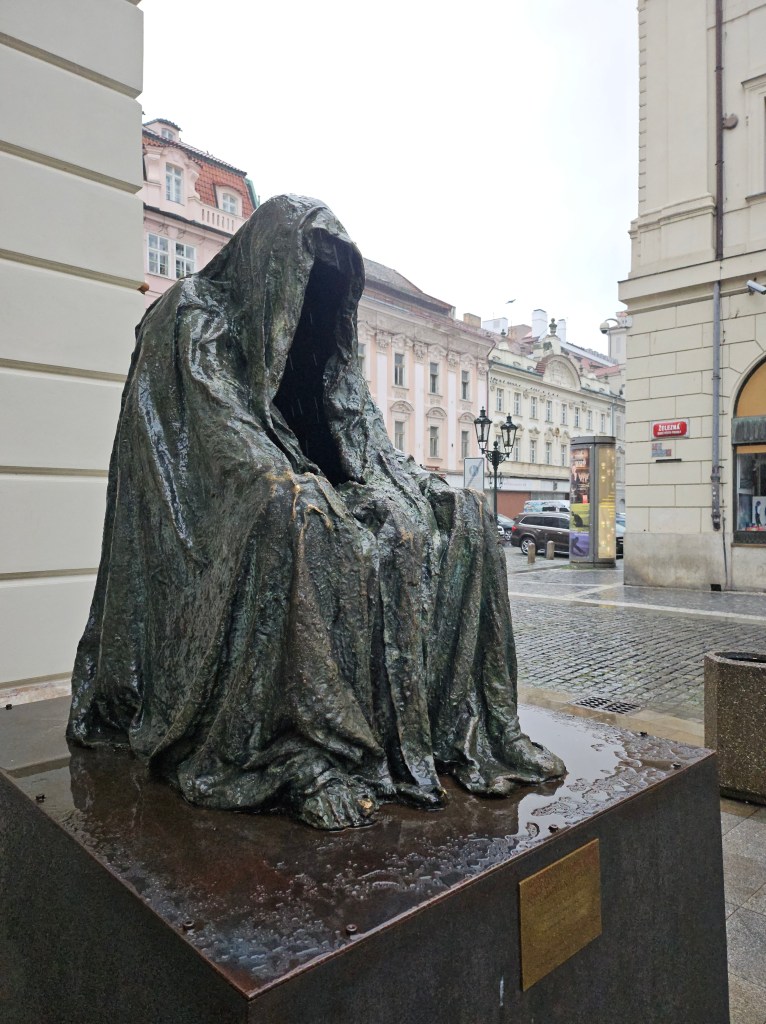
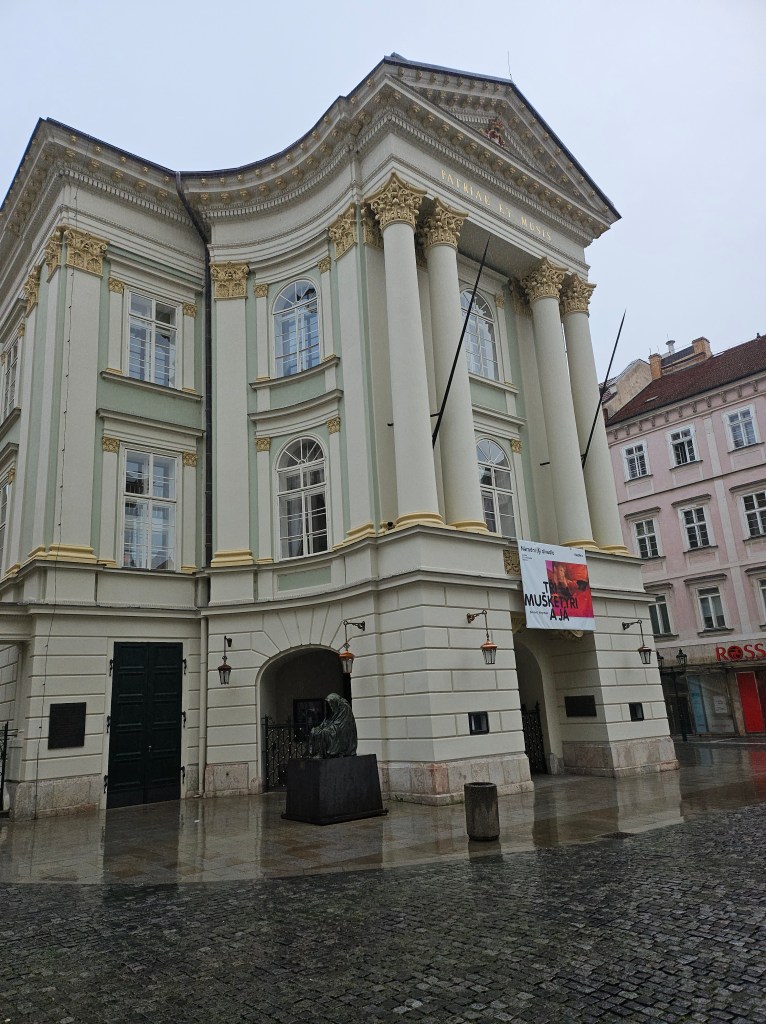
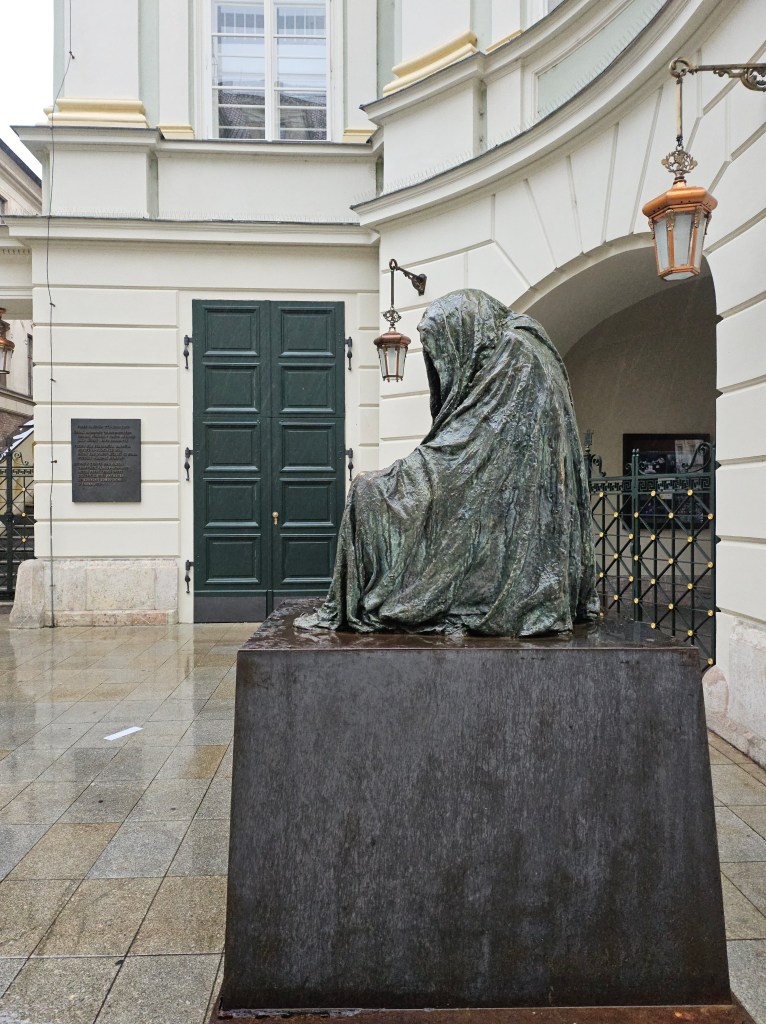
There are pluses and minuses to using a conference as an excuse to travel. In general, I find the pluses outweigh the minuses in the long run: sometimes you can get a grant to help cover the experience, you have a built-in reason for being somewhere and are often among people who are eager to make friends or at least grab coffee, you get to see places that the regular tourists might not go, and so on. The minus, however, is a big one: you are not going to see very much of the city beyond the conference venues unless you leave the conference. Case in point: for the first three days I was in Prague, I walked by the opera house where Don Giovanni premiered and the city’s famous astrological clock without even registering them, because I was running late. Whoops.
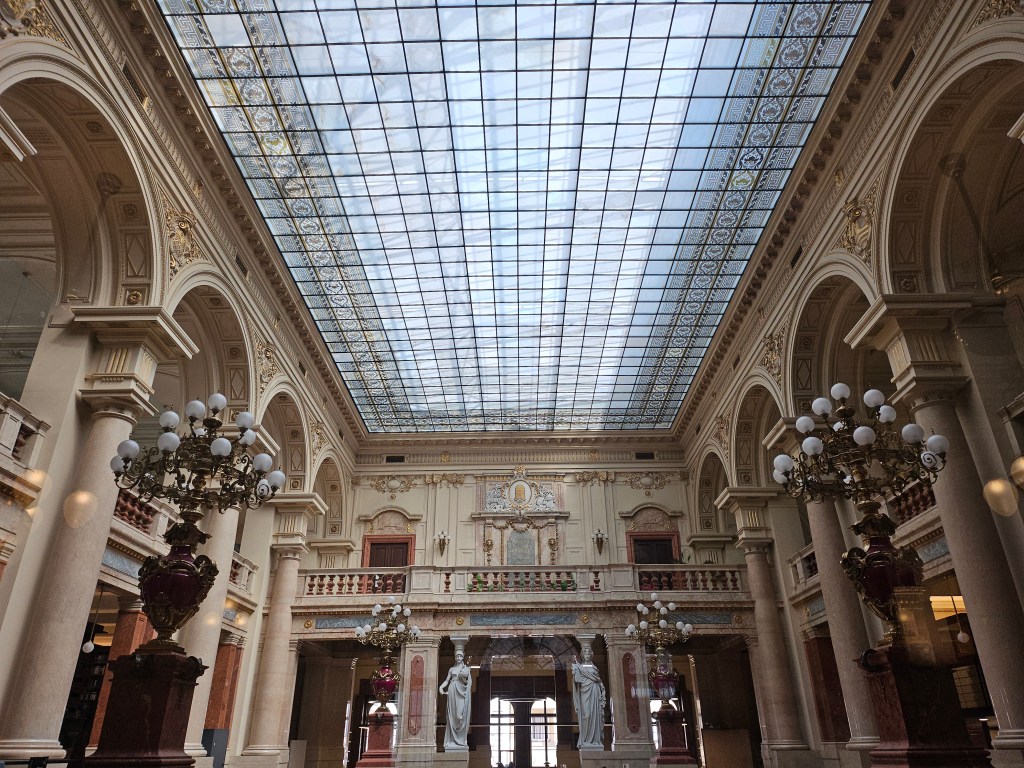
I have wanted to see Prague for longer than I have had any real sense of what it even looked like, and when I saw that the Memory Studies Association was holding its annual conference there this year, I jumped at the chance. Memory Studies is a young field, built on the shards of the Holocaust and other histories that are so difficult that they challenge the very idea of straightforward history and easy narratives, and it seemed fitting that such an entanglement of shadows and fog would come to a place that I first knew through its stories, rather than its history. Most famously, Prague is the home of the legendary golem, the creature of clay said to have been created by a rabbi in order to rise up and protect the Jewish people when necessary. But even the historical events I learned about that were centered in Prague – from the Defenestrations all the way to the Velvet Revolution – were cast in a mythic light, somehow detached from a real physical place. Praga, mater urbium, goes one of the city’s many mottos: Prague, the Mother of Cities. If there is a place built for legend, this is it.
I arrived in Prague a day before the conference to get settled in, and took the Airport Express into the city on roads so quaint that I wondered whether Czechia has any highways at all. Embarking at the central train station, I looked first not for the red roofs or a view of the skyline but for a statue I had read about many years before: Woodrow Wilson, first dedicated in 1928, for the work he had done after World War I to help establish the nation of Czechoslovakia. We forget, in the litany failures of the Treaty of Versailles, that there were some small victories. This perhaps was one of them: a democratic state built from the ashes of the Austro-Hungarian Empire, the achievement of a national dream of Czechs for many centuries. In a symbol of their pride in both the New and the Old Worlds, the statue was funded by Czechoslovakian immigrants in America, and it stood in front of Prague’s central train station until it was destroyed by the Nazis in 1941. The Czech government, along with the help of later generations of American immigrants, finally rebuilt the statue and rededicated it in 2012.
SVÊT MUSÍ BÝT ZABEZPI ČEN PRO DEMOKRACII, reads the inscription at its base, a phrase I recognized even before I plugged it into my translator: “The world must be made safe for democracy.” We have largely dismissed Wilson in the United States for his failure to secure democracy at home and for his larger failure to deliver on this promise across the colonized nations of the world. But in Czechoslovakia, he made good on his promise. How much more important his words must have seemed during the years of Soviet rule. How much more important they seem to us all, now.
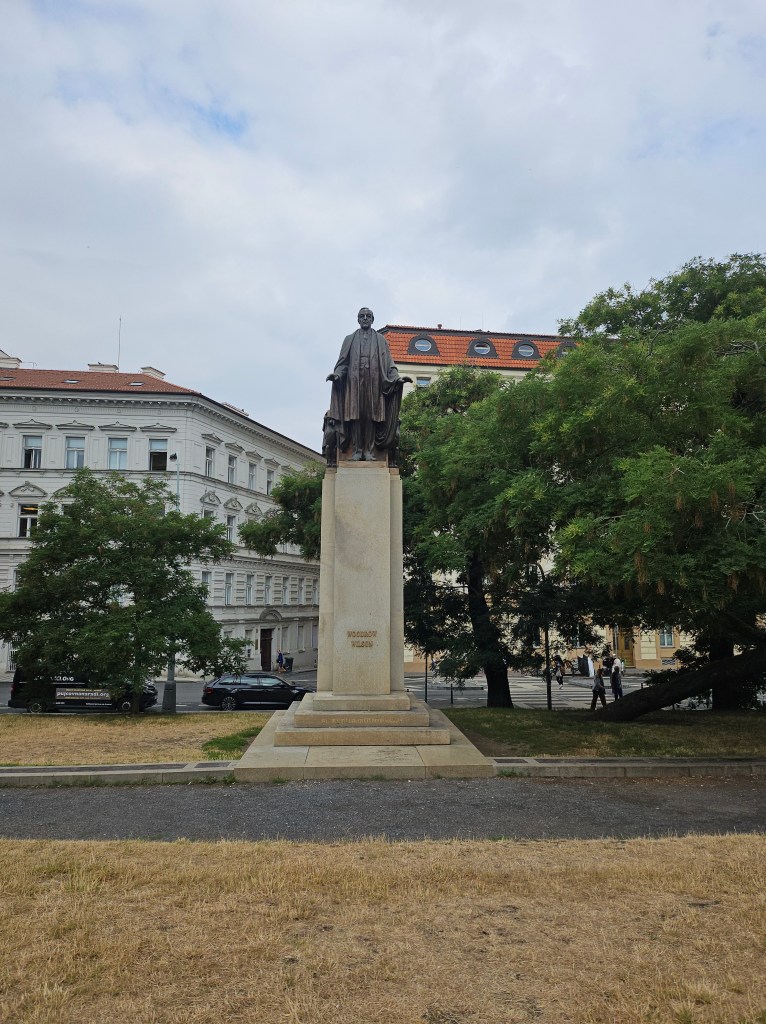
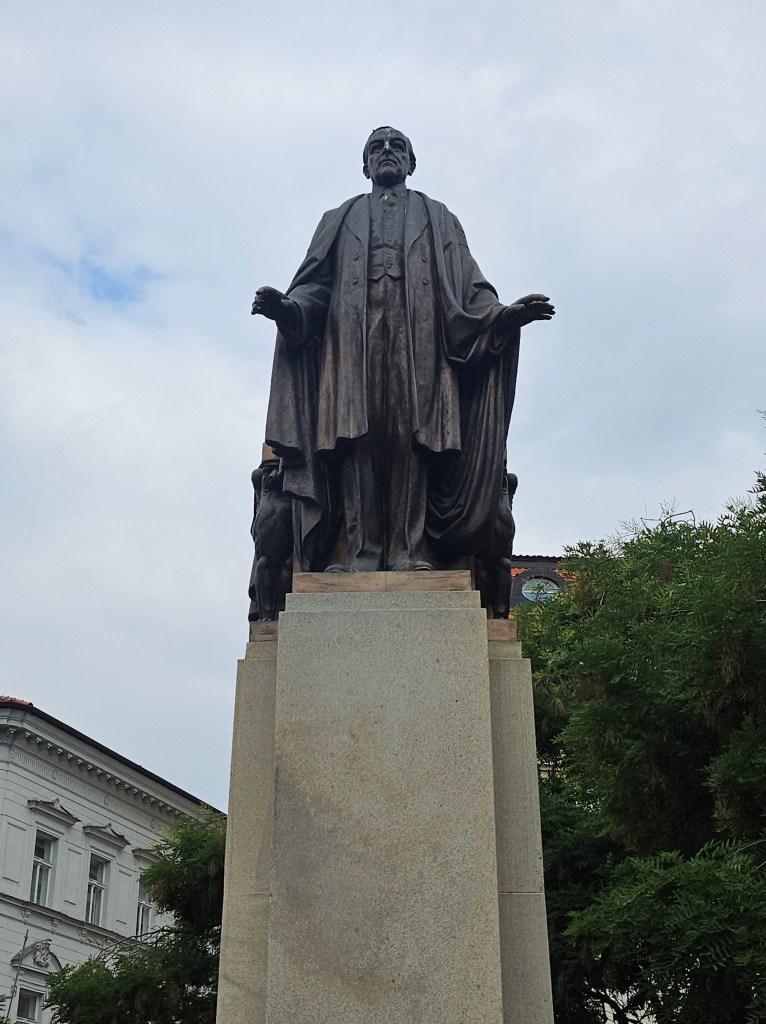
I turned out of the park and crossed George Washington Street, another reminder of how much the American story once meant to the world, and promptly spent most of the rest of my day inside working on my conference paper. (You’re only a true academic, the joke goes, when you stop preparing your conference papers diligently in advance, and start writing them on the plane). Still, I had to eat, and even though I did not seek out any of the famous sites on my way to a grocery store, already what I saw was enough to stop my breath.
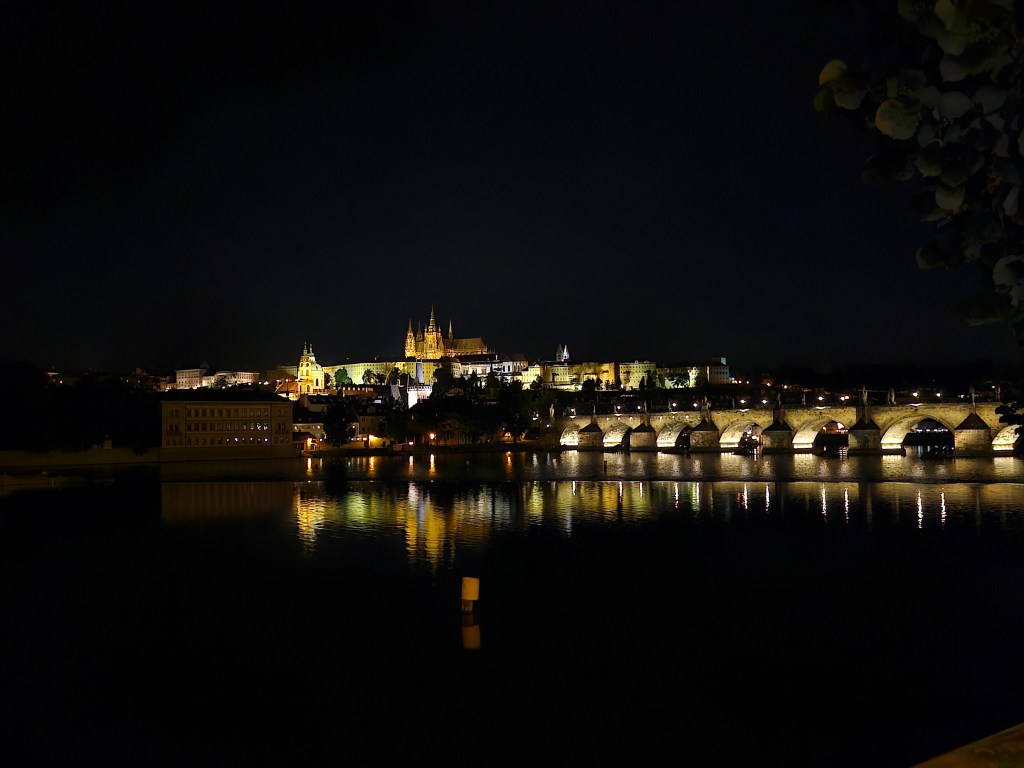
Prague’s New Town and Old Town are misleading for us hapless Americans: the New Town was founded by Holy Roman Emperor Charles IV in 1348, back in the hic sunt draconis stage of global exploration. The Old Town dates from the ninth century. The city is a marvelous time capsule of architecture spanning from those early beginnings to the present, reined in by a commitment to beauty and uniformity, if not in exact design, in the city’s overall aesthetic. Prague was spared the volley of bombing during World War II for reasons not entirely clear (various reasons I saw given included poor strategic location, the desire of Hitler to preserve sections like the Jewish Quarter as a sort of museum space, and—my favorite—American sympathy towards the Czechs, knowing that deep down they were Allied sympathizers), but they have left the city almost entirely intact across its history. A few American bombers hit the city thanks to miscalculations during the bombing of Dresden, destroying a church and a synagogue, but beyond those few holes, even the Communists did not attempt to Sovietize the center of the city. From the Vltava River, there are wonders old and new in every direction: the Dancing House, Prague Castle, the Charles Bridge, the opera and symphony halls (the latter of which has, of course, a statue of Antonin Dvorak in front), and the everyday buildings, all of which are detailed in bright colors and ornate carvings. Mother of Cities, indeed.


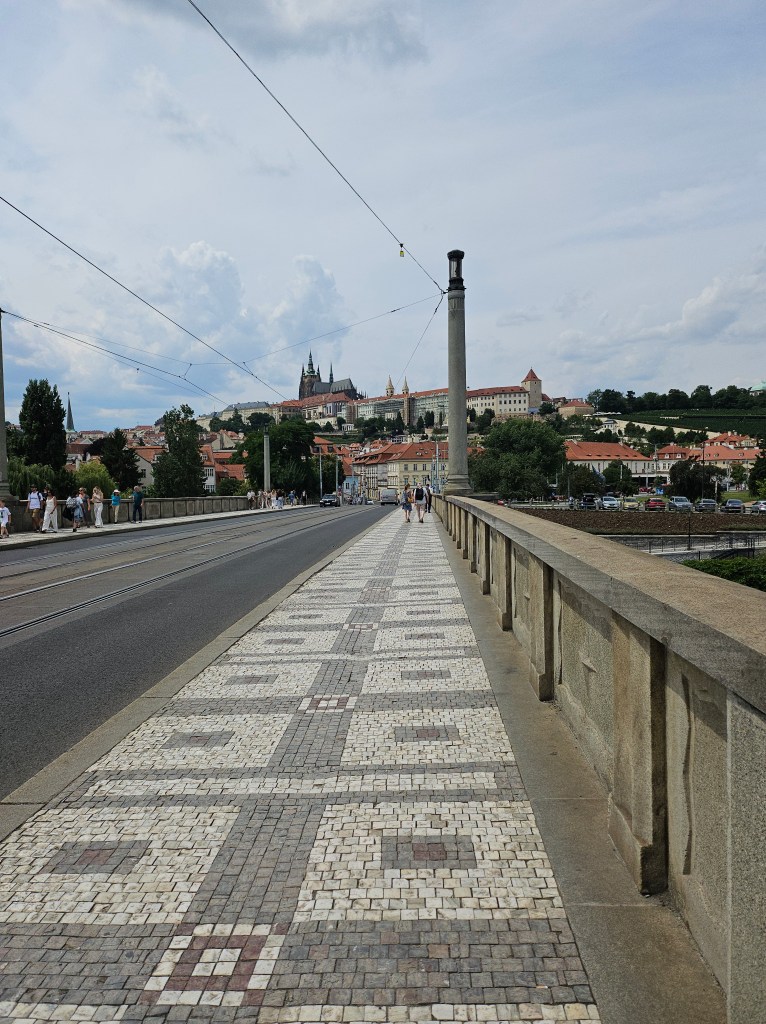
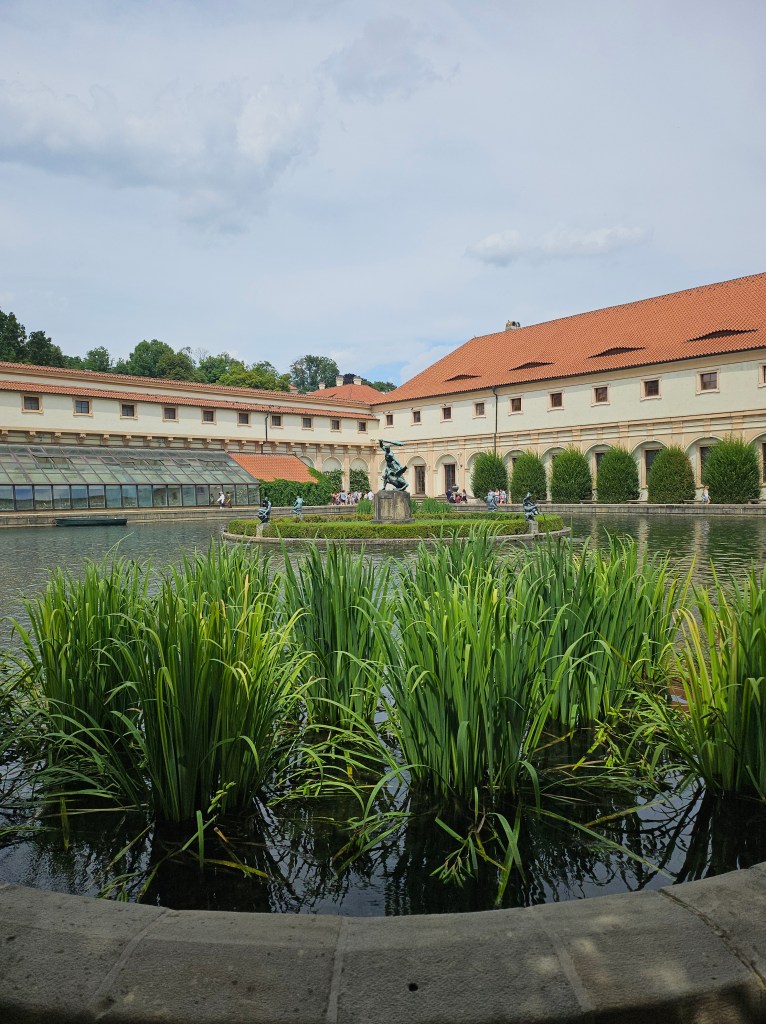
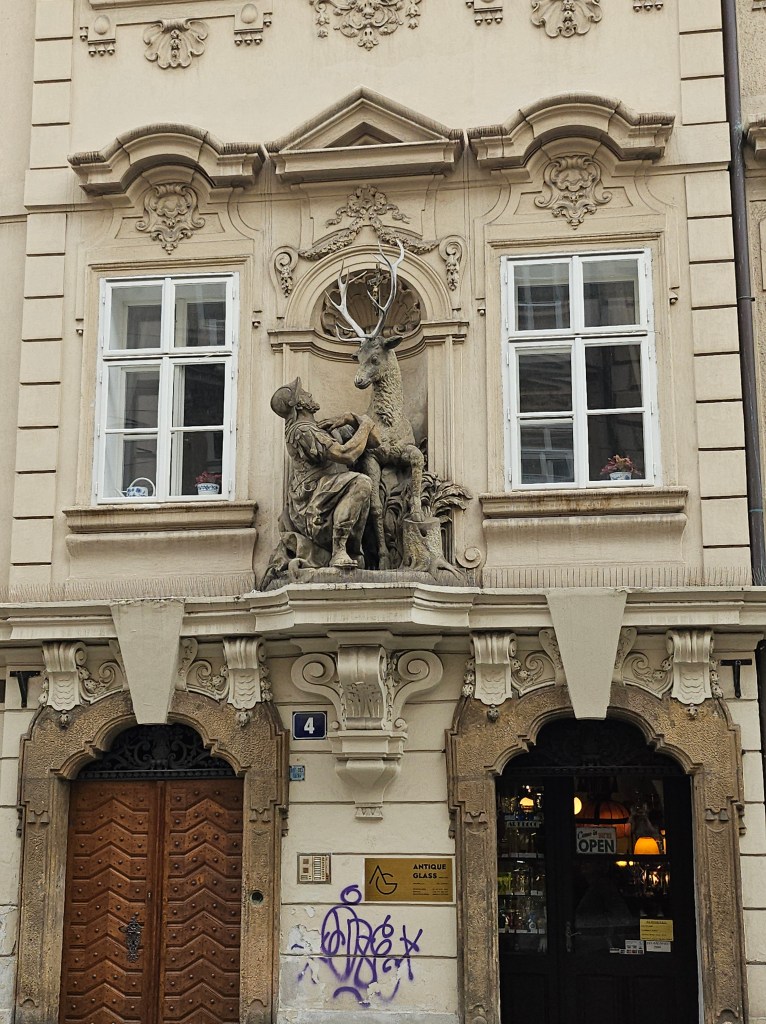

Cloaked in such beauty, the city wears its history of antisemitism more lightly than others I have visited. Charitably, this might be because it was a center for Jewish life for much of its history. Less charitably, it might be because while there were 60,000 Jews in Prague alone on the eve of the Holocaust, there are now only 1,800 in the entire country. The whole thing made me a little uneasy. I spotted my first Stolpersteine, the stumbling blocks that mark a Jew’s last voluntary location before the Holocaust, on my way back from the grocery store that first night. It was a family of three:
Here lived
Camilla Franklová
Née Hellerova
Born 1890
Deported 1942 to Terezin
1943 to Auschwitz
Murdered Mar. 8, 1944
Here lived
Theodor Frankl, MD
Born 1881
Deported 1942 to Terezin
1943 to Auschwitz
Murdered Mar. 8, 1944
Here lived
Lilly Franklová
Born 1921
Deported 1942 to Terezin
Died Feb. 2, 1943
Terezin
Terezin (often better known to Americans by its German name, Theresienstadt) was the Nazi’s model concentration camp, the place that Red Cross workers and foreign emissaries were brought to demonstrate that in fact the Nazis were not up to anything nefarious, that their detention camps were just like any other camps. It is about 60 kilometers from Prague. Most of the model Jewish prisoners, as in the case of the Frankl family, were deported further east once they had served their purpose. Some, like Lilly Franklová, committed suicide before they left the camp. Maybe that was what was meant by a model camp: the prisoners did the work for their captors. I did not visit.
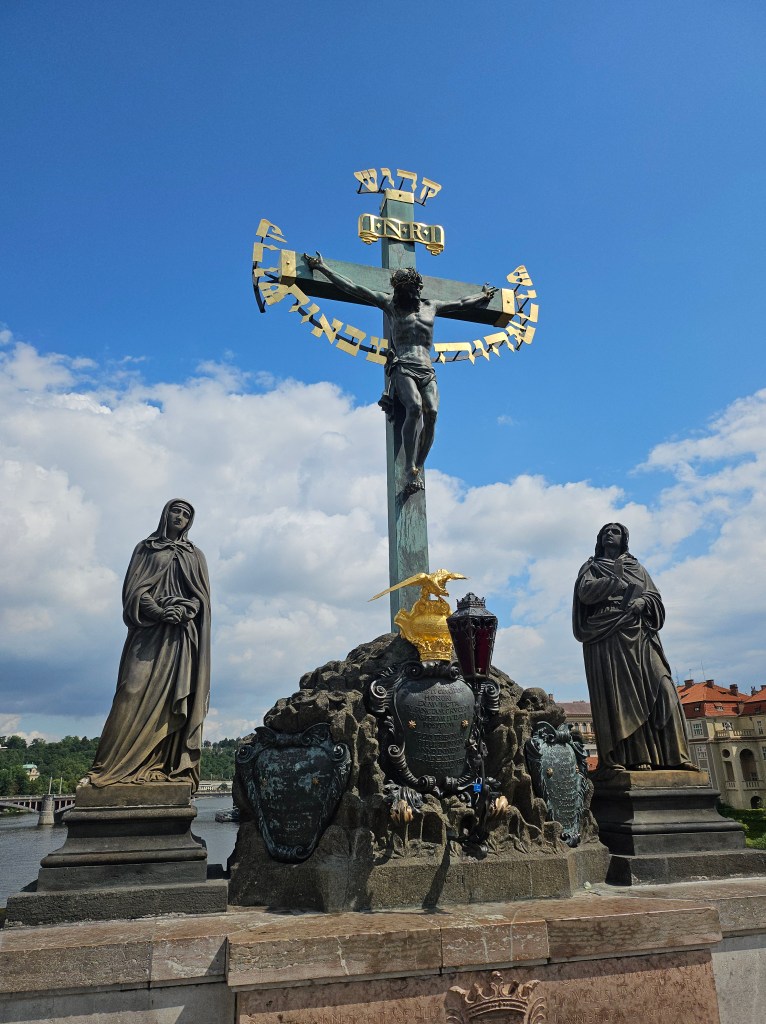
Stolpersteine can be found in many of the cities that boast a vanished Jewish population. What cannot always be found is visible and unapologetic reminders of their humiliation. Walking the Charles Bridge on the afternoon of the first day of the conference, I was stopped in my tracks by a statue of Jesus on the cross (the statue’s formal name is The Calvary), surrounded by one of the holiest lines in Jewish liturgy in four-inch-high gold letters: Holy, holy, holy is the Lord of Hosts, complete with the four-letter name for God, shimmering in the sunlight. I had a sinking feeling that I knew what had happened, but I looked it up anyway to confirm. In 1696, a Jewish blacksmith had been accused of debasing the cross, and the city had forced him to raise the money for the gold to place around Christ’s head, a permanently visible symbol of Jewish humiliation for the city. A rabbi had asked the city to at least add a plaque explaining its presence in the early 2000s. The plaque – which is in Czech, English, and Hebrew – does not offer an apology, only an explanation of how it came to be. We are not the only ones who struggle with the central problem related to removing offensive statues: apathy, a sense that we have already done enough, and the feeling that there is no one left alive to care.
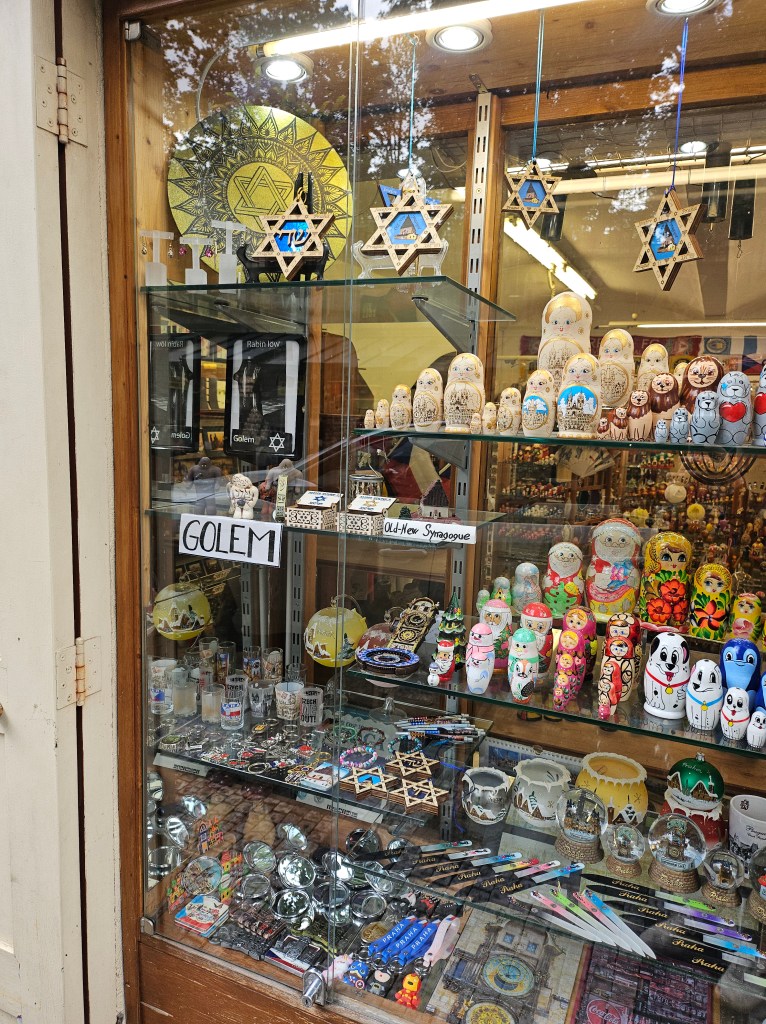
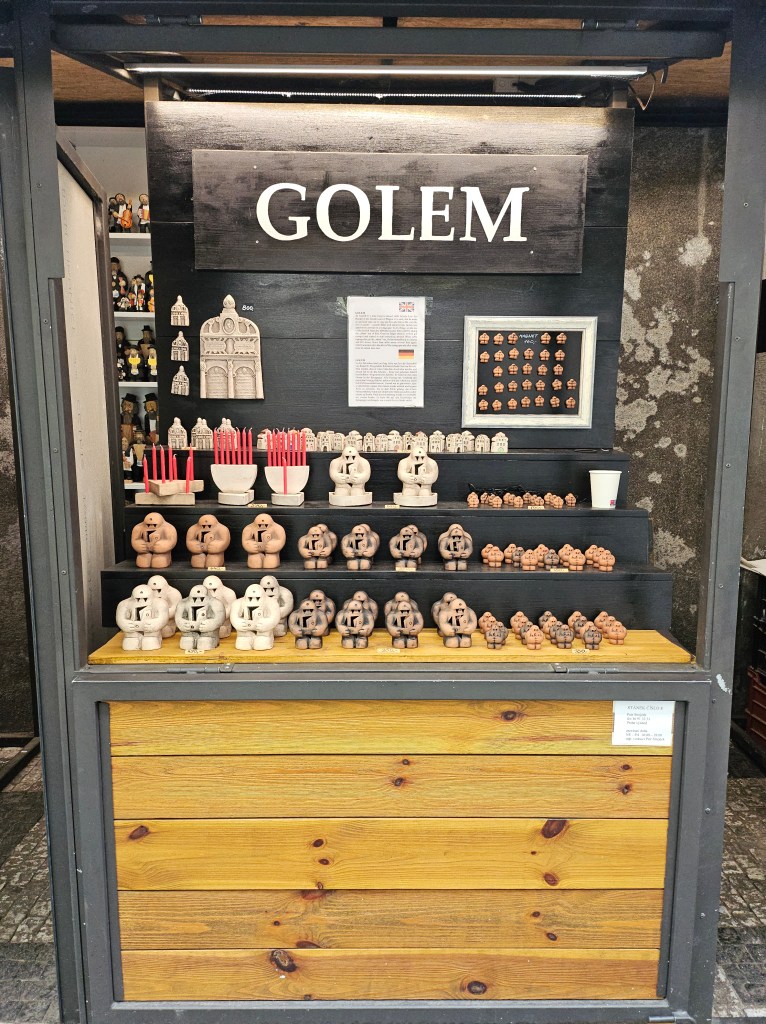
Prague’s Jewish Quarter, though superficially as beautiful as the rest of the city, is a nauseating place: once a center for Jewish life in Europe, it is now filled with souvenir shops and well-meaning tourists, come to see a museum of historical Europe. We owe a debt of thanks to the golem, at least: the shops mostly sell his figurines alongside their Judaica, rather than Jews that you can rub for good luck with money (popular in Poland). It is home, amongst other things, to the longest-continuously-functioning synagogue in Europe, an early example of Prague’s medieval architecture that dates from 1270. These days it is open to visitors during the day, and used by the Orthodox on Shabbat: it features a three-foot brick wall that serves as the mechitza (divider between men and women), which still really appeals to a certain branch of the Jewish people. Other synagogues host nightly concerts, or serve as a museum. I made a good faith effort to visit the museum, which grants access to Prague’s famous cemetery, and found I could not cross the threshold. In fact, I was unable to go into any building in the Jewish Quarter. Like the golem, it may be a perfect physical specimen, but it has no soul. I could not bring myself to disturb its rest.
Visitors interested in getting an “authentic sense” of Prague’s Jewish population might do better across the river at the Franz Kafka Museum. The writer, who lived in Prague for most of his life, was an admirer of Yiddish theater and later a Zionist, though he never practiced religiously. The museum is Kafkaesque, as of course it would be: most of it is pitch black with lighted boxes (not great for anyone with disabilities), and you go through rooms filled with filing cabinets and dimly lit hallways with hard-to-read quotes about the city of Prague and how it does and doesn’t manifest in his books. They don’t bother much with the Metamorphosis, since it’s the book that most people probably know, but there are homages to The Trial and The Castle all over the place. Most interesting to me, however, was a section on Kafka’s reflections about Judaism: his sense that it set his father apart from the rest of the city while also giving him a different kind of insight. That seemed a much truer reflection of the city’s Jewish population’s lives than the deadened Jewish Quarter.


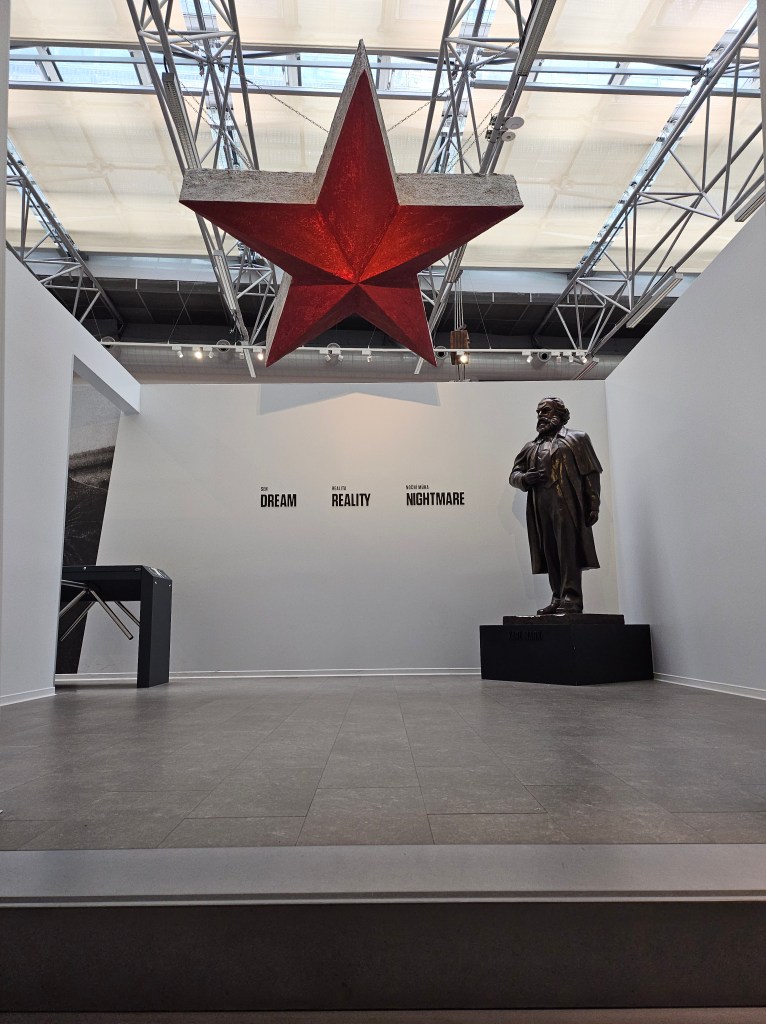
Kafka’s bureaucratic nightmares were set primarily in the years of Habsburg control of the city, but if you want a different, decidedly nightmarish bureaucracy, you can visit the Museum of Communism, not far from the train station and just outside the borders of the Old Town. Normally I like to read authors writing about the places that I am currently visiting, but for Prague, I had brought along Arthur Koestler’s Darkness at Noon, the anticommunist, antitotalitarian novel of the 1940s that warned against the spectre of Stalinism before it reached places like Prague. The Museum of Communism validates his warnings. Moving from the takeover after World War II to the Velvet Revolution, it shows the ways that freedom was choked off under Soviet control, the denied opportunities, the destroyed prospects, and perhaps most of all the lives lost in detention centers and in desperate efforts to escape. The museum uses tour guides who grew up under Soviet control to tell visitors – both foreigners and those too young to remember – what it was like, and how glimpses of the world beyond the Iron Curtain changed the course of their lives. The woman leading a tour group when I visited had spent a year in Texas, and she told the visitors frankly that her time in America had opened the world to her.
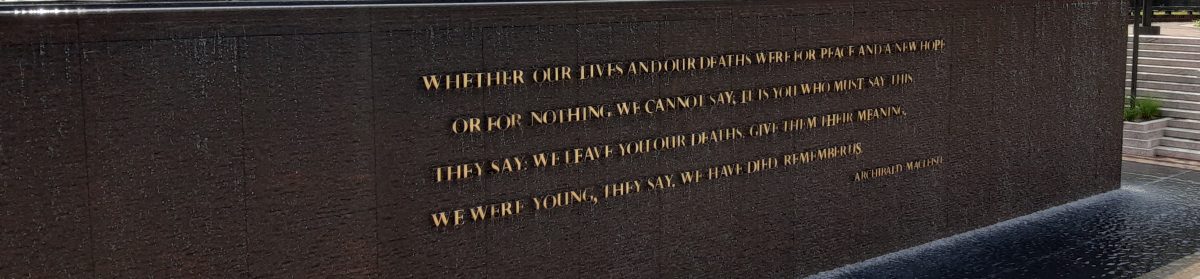
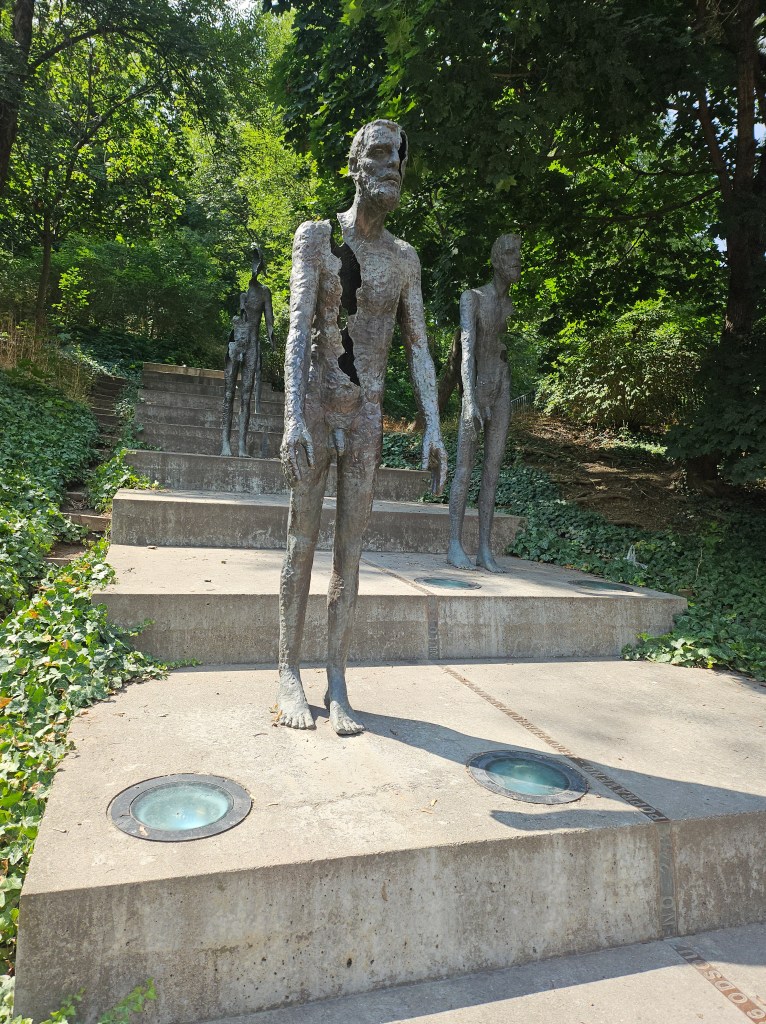
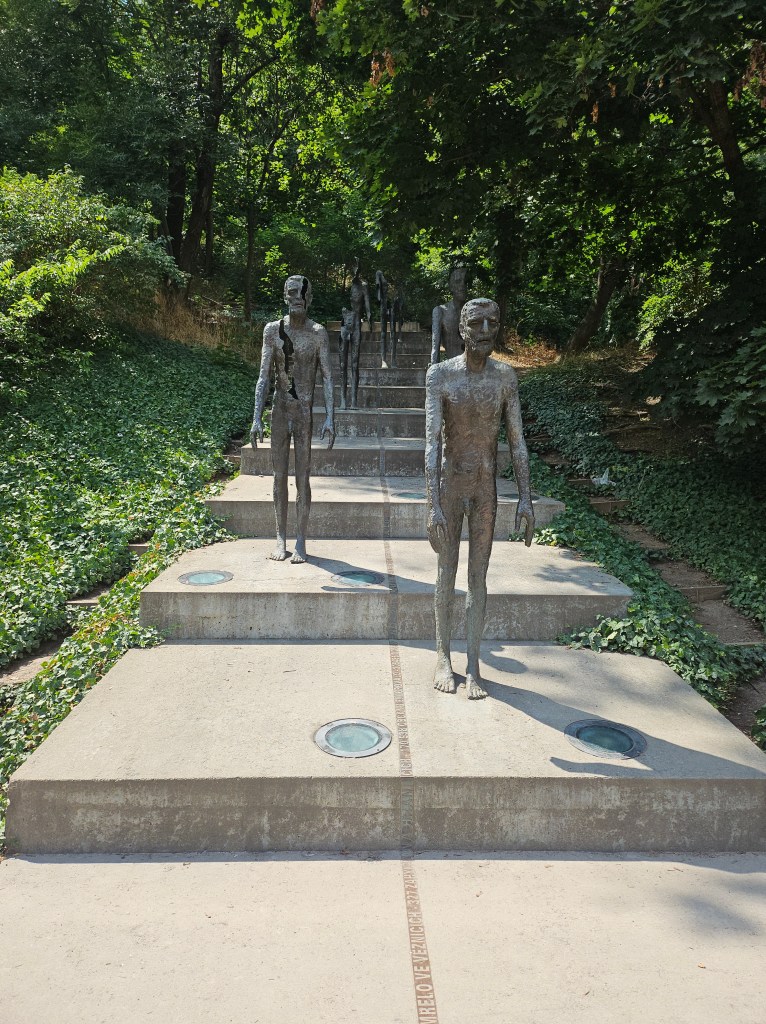
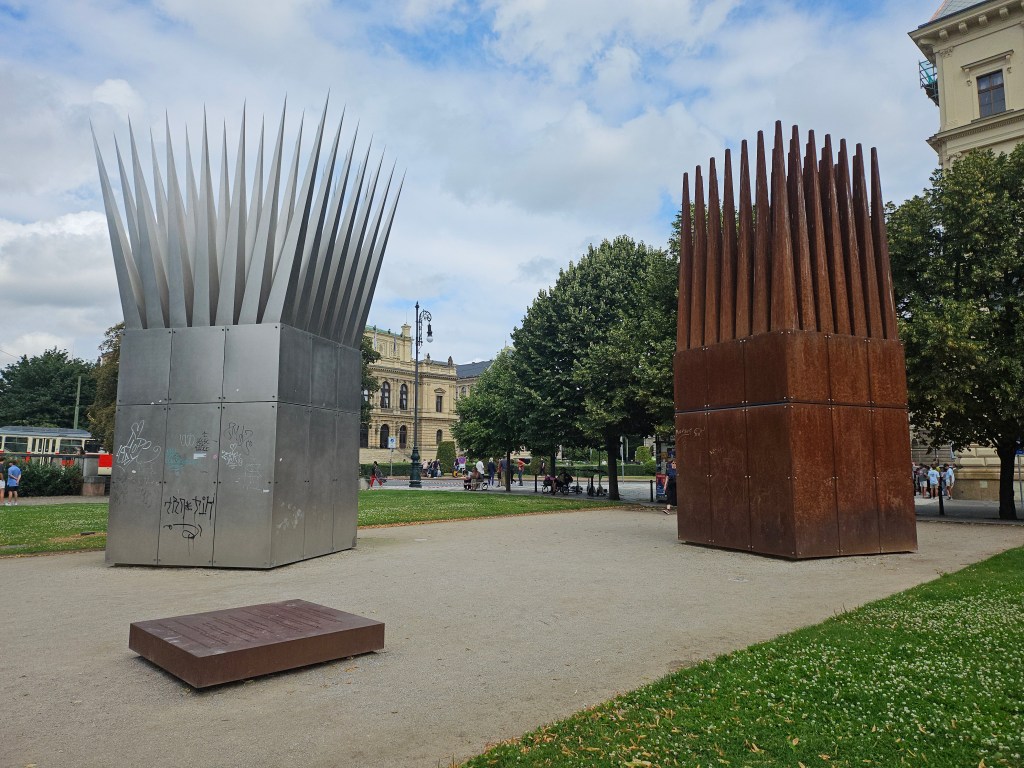
Although Soviet architecture never permeated the city, there are plenty of memorials to remind denizens of life under communism. Many honor the students who stood up in protest: a memorial to the protests of 1948 praises students for remaining true to their beliefs. By Charles University’s Faculty of Arts and Sciences Building, a two-part memorial honors one of the students who self-immolated in 1969 in protest of the violent shutdown of the Prague Spring. A silver array of spikes honors him, while a rusting array of spikes honors his grieving mother. He remains ablaze; she is left behind with the ruins. Elsewhere in the city, the Memorial to the Victims of Communism shows pieces of the human form slowly making their way down a flight of stairs, struggling to become whole. This memorial to the victims of communism dedicated to all victims, reads its inscription, not only those who were jailed or executed but also those whose lives were ruined by totalitarian despotism.
The Museum of Communism ends with an image of Václav Havel, the first post-Soviet president, addressing Congress in 1990, with the quote, “Human rights are universal and indivisible. Human freedom is also indivisible: if it is denied to anyone in the world, it is therefore denied, indirectly, to all people. This is why we cannot remain silent in the face of evil or violence; silence merely encourages them.” Nearby, a poster proclaims UKRAINE, WE STAND BY YOU. The text below suggests that the Czechs remember what some in America wish to forget: “The determination of the Ukranian people to defend their country and nation against an overwhelming majority and die for their freedom, show [sic] the whole world what real courage means. We might have wanted to believe, but with their actions, Russia has yet again shown that they do not care to have a place in the civilized world.” Throughout the week, there was a sober pall over the conference whenever I spoke with those who study America, as we wondered whether Americans were ready to cast that freedom aside in favor of depotism, whether it was already too late to turn back. The Czechs offer us a reminder of what exactly at stake in this debate – a grim reminder, but a necessary one.

I attended Shabbat services on Friday night, back in the Jewish Quarter – in the old Jewish Town Hall, the only Jewish building I ever got inside. Like most places in Europe, you had to call ahead so that security (might) leave you alone. Ahead of me, a British couple who had not had this foresight were undergoing the type of interrogation I usually associate with Ben Gurion Airport: can you name any Jewish holidays? Which ones? What’s your favorite? Do you speak any Hebrew? How did you learn it? What’s the next holiday on the calendar? What’s the weekly Torah portion? I am not sure they ever got in; their answers spoke of a cultural Judaism that the security guards were not prepared to admit into the parameters of the synagogue. Sorry as I was, I was also somewhat charmed by their innocence: how nice to know that there are some people, somewhere, who think that you should still be able to walk up to a synagogue unannounced and be received as a fellow petitioner of God.
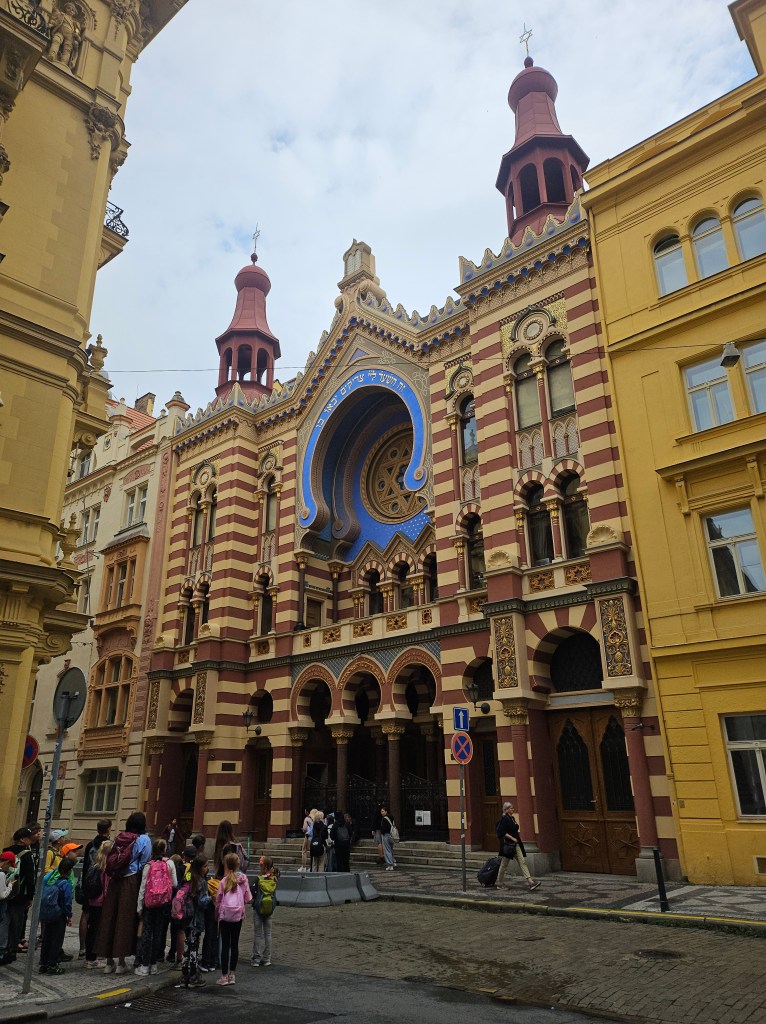
Prague’s active Jewish community consists of some 15 or so people, who, true to form, all go to their respective synagogues to worship on Friday night and sacrifice any hope of a minyan (the mandatory quorum of 10) in order to worship as they see fit. The group I visited that evening consisted of two locals (though one, the rabbi, was originally from Skokie, Illinois) and seven tourists – just short of 10. In the morning, however, they all gather at the Jerusalem Synagogue outside the Jewish Quarter to worship together, to keep as many synagogues active as they can and to allow mourners to recite the Kaddish. Such a service must adhere to orthodox standards, of course, but the rabbi informed us cheerfully that women were allowed to ‘participate’ in the service (read: offer names of the sick for healing, and be seated in the back but not behind a three foot brick wall), and that for a girl’s bat mitzvah, she was now even allowed to stand silently next to her father while he did the Torah reading for her. I am not, I reflected as I heard this, one who pines for a life among the last Jews of Europe. Give me America any day, where Jewish culture has thrived and we have resolved these questions decades ago. It was by no coincidence that my favorite (exterior) of the synagogues was the Jerusalem Synagogue: built by Reform Jews in the 1800s, it makes a plea to understanding among the larger community of Prague in Czech, Hebrew, and German, asking:
Do we not all have one father?
Did not one God create us?

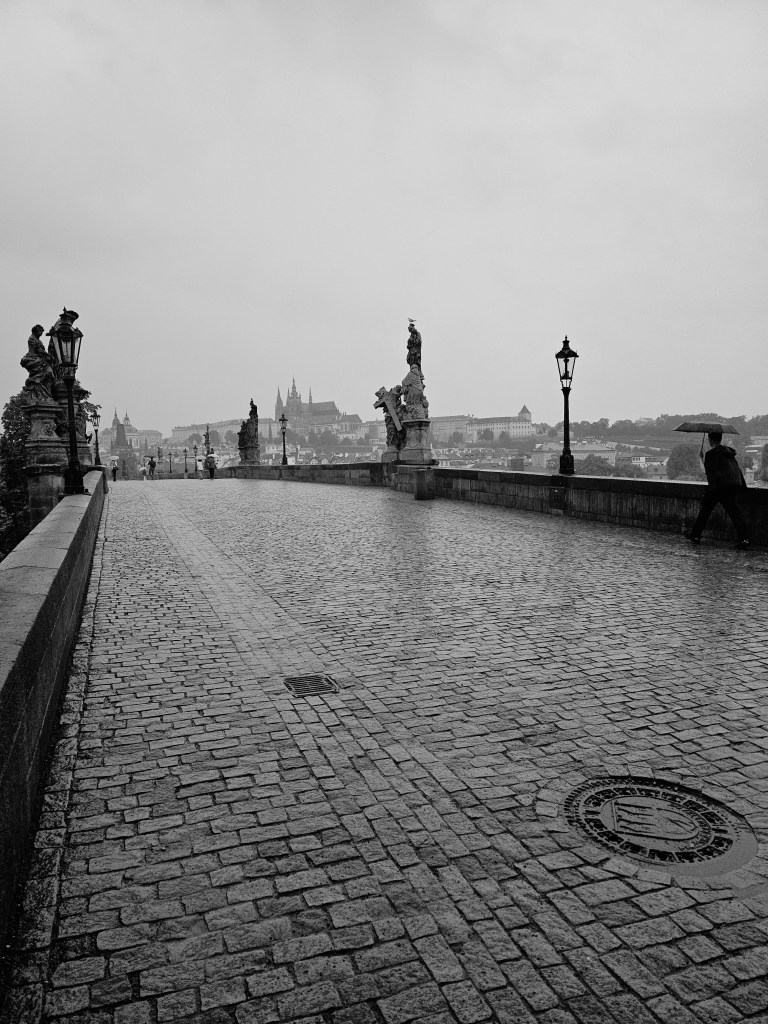
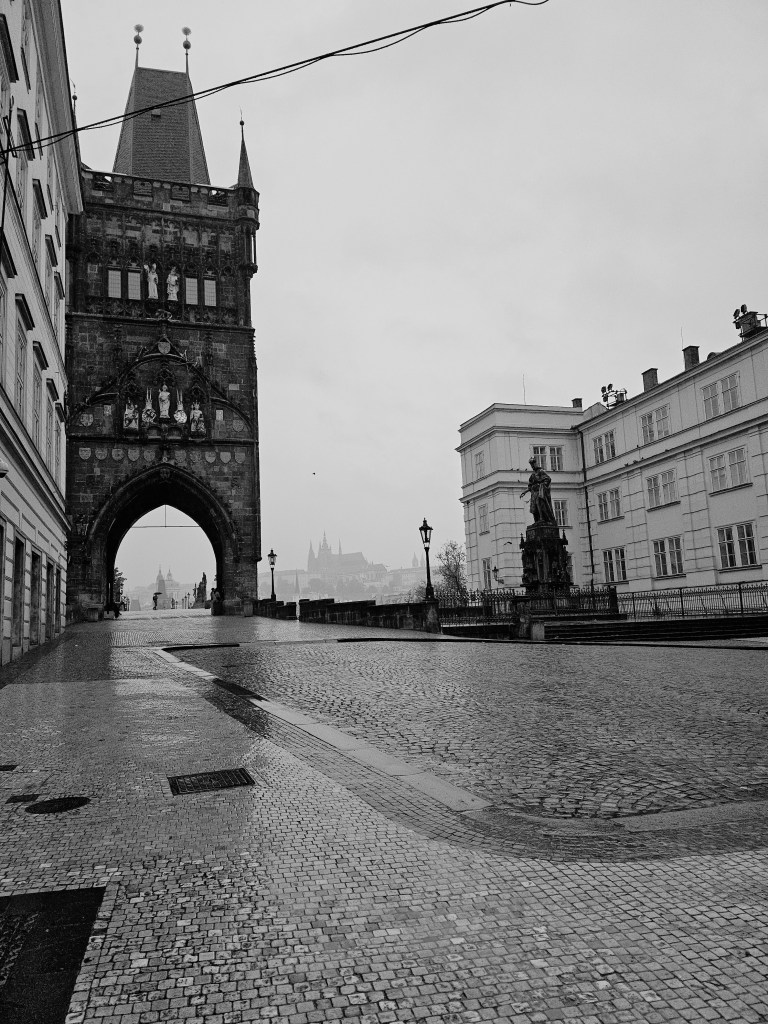
The conference did not give me time to visit the city’s many art museums or the Czech National Museum, but I like to think that that leaves me a to-do list for a future trip. There was one place, however, that I wanted to see properly, gold-haloed Christ and all. The Charles Bridge is absolutely mobbed every day with tourists; you cannot hope for a respite even late at night. So two days before my departure, I took a friend’s advice (thank you, Kathy!) and went to see the bridge at 5am instead, where the early hour and the rain of the morning kept nearly everyone away. Without people, the city seems to revert to its oldest self, a place suspended in time. I watched a few people hurry by under their umbrellas and thought of all the others who must have done the same since the bridge began construction in 1357 and wondered if they felt the same sense of awe that I did. Much has changed, of course, even here: the Germans and the Jews have vanished, a light rail and subway system service the whole city, even at 5am, there were one or two people out wielding selfie sticks. But the city feels trapped in amber all the same, as if it is a place where the past and the present can still exist alongside each other.


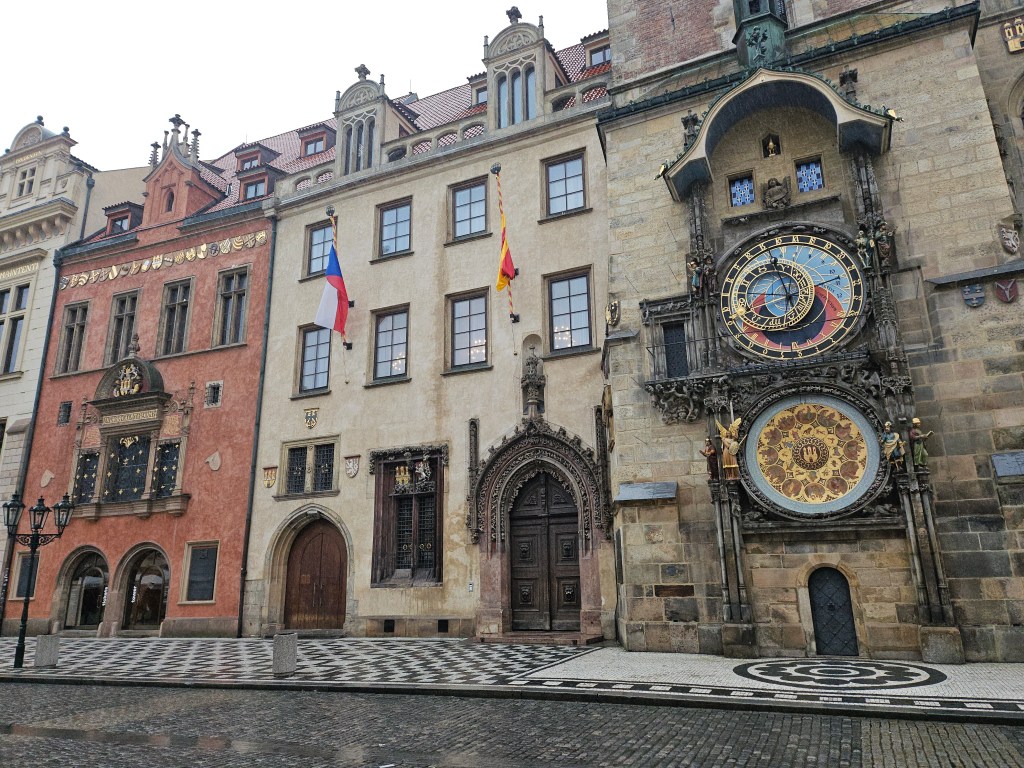
I walked home by way of the Astronomical Clock, also, for once, bereft of visitors. The clock’s sounding, wherein a little skeleton plays a tune to remind us of our mortality and the relentless passage of time, attracts quite the crowd during waking hours. But it does not begin to sound until 8am, and so for the moment, I had it mostly to myself. The clock represents the city in miniature in some ways: different elements have been added throughout the centuries, making it a mishmash of different stories, and though it has sustained damage at times, the legend has sprung up that the welfare of the city is dependent on the welfare of the clock, and so it remains in good care. It speaks to the unity of art and science, to the city’s history, and perhaps above all to the people who have cared for and loved the city through all that time. Do we not all share a creator? I found I could not resent this city, despite the more difficult parts of its past. Perhaps that is because it belongs to the world, not only to its residents – to history, and not only to its present.
Notes & Bookstores, for the Curious
Cash: I have gotten by just fine in many countries with little to none of the local currency. Not so here. Public toilets are usually 20 Koruna to use, and they will not take credit cards. Plenty of places are still cash only or strongly prefer cash – better that you can get on the waitress’s good side by giving it to her.
Security: Outside of the Jewish Quarter, the approach to security here was totally baffling to me. At the airport, you clear customs, hit duty free, and go all the way to your gate before you reach security, meaning that you can’t buy a coffee in the terminal and then bring it on board. Elsewhere, such as Prague Castle, there were metal detectors up and running, but no one seemed to be using them for anything. Hard to say what accounts for this, but I came to appreciate the absurdity.
Summer: this was my first time going to Europe in the summer, and while it couldn’t be helped thanks to the timing of the conference, I would not do it again by choice. There are too many people to see anything, and the locals themselves have fled. Even when it cools down at night, most of the major sites remain packed: pretty enough to photograph at a distance, but not good for careful study.
Bookstores: One of the benefits of speaking the lingua franca is that you can often find English language books even in countries that are resolutely focused on their national language (I noted that while there are plenty of German tourists, German as a language of the republic has been firmly stamped out since Kafka’s time). Some stores, like Academia, near the Czech Academy of Sciences, have excellent small collections of English translations of great Czech writers. And just across the Charles Bridge, the shop Shakespeare & Synové (Shakespeare and Sons, an undoubtable reference to Paris’s Shakespeare & Co.), maintains an impressive collection of English language books packed across two floors. I even found something there that neither my local public library nor Brown’s library had in stock.


 Much That Is Fair