
“‘I’ve been over a good part of the world since I left it, Doctor Watson,’ said he; ‘but I have never seen a place to compare with it.’
‘I never saw a Devonshire man who did not swear by his country,’ I remarked.”
– Henry Baskerville & Dr. Watson, The Hound of the Baskervilles
Of all the places I planned to visit on this trip, only one was really completely inaccessible by train. The National Rail service is very good, of course, but they don’t go everywhere, and remote abandoned castles by the seashore are apparently on the list of places they assume most folks won’t want to bother with. For a moment, I considered taking that as a sign. But then I figured it wasn’t like I was going to have another opportunity coming along in the near future, and so off I went.
The location was Tintagel Castle, and the source of my fascination with it is a myth. At some point in the Dark Ages the place gained a very faint connection with the stories of King Arthur: it was said that Uther, Arthur’s father, had conceived Arthur there, while magically disguised as the Duchess of Cornwall’s lawful husband, a story made famous by Geoffrey of Monmouth’s 12th century saga History of the Kings of Britain. Arthur wasn’t born there, nor did he live there or rule from there, and yet the kernel of the story planted in Tintagel (along with its slightly more plausible status as the setting for the Arthurian legend Tristan and Iseult) became so popular that a new castle was built there a century later by the Earl of Cornwall, perhaps in a bid to win over his new Cornish subjects. And once Alfred Tennyson used it as the setting for a reimagined birth of Arthur in The Idylls of the King, his retelling of Thomas Malory’s Le Morte d’Arthur, it became a tourist site for Arthur aficionados as early as the nineteenth century. There is nothing historically Arthurian to see there, and yet I felt I had to see it. Part of the study of memory is understanding the power that myths and legends hold over the popular imagination even when they are not based in truth, and after all, there is hardly a more famous founding myth than King Arthur and his Round Table.
Tintagel is really hard to get to, though, and so I abandoned my original plan of staying out on that part of Cornwall’s coasts for a few days when I imagined either a) renting a car and plummeting to my death when I accidentally drove it off the left side of a cliff or b) hauling my suitcase off and on no less than one subway, two trains, and two buses in each direction. I decided to split the difference: I would take the Tube and the two trains as far as Okehampton, a town in the neighboring county of Devon, and then I would settle for a day trip on the two buses into Cornwall and back.
I had good reason for wanting to stop in Okehampton, anyhow. The town, which is more than 2,000 years old and surrounded by hills that show evidence of human settlement from at least the Bronze Stone Age, lies at the northern edge of Dartmoor National Park, made famous as the setting for The Hound of the Baskervilles, perhaps the best-known of all Sherlock Holmes stories. I have been to 221B Baker Street in London, of course, but everyone knows that the museum there is a little tacky, and so just as I figured one could honor Holmes better from walking London as he saw it, here too, I thought that heading to Dartmoor might be a better homage.
If by now you are thinking, gosh, this really doesn’t sound like a research trip, you are correct. Approximately 25% of this trip is real research of one type or another, the rest is a step back. Some of you may know that I am on the academic job market this year; all of you know, since it’s pretty much a cliché at this point, that it is nearly impossible to secure an academic position with a humanities PhD, a problem that has nothing to do with anyone’s individual talents and everything to do with the devaluation of the study of what makes us human in this day and age. I last came to England for a proper trip in 2019, the fall I was applying to graduate school. It was a clarifying week for me in a number of ways, as I worked to determine what sorts of things I was interested in and what I had been doing just because the people around me wanted me to or because I thought I should. Sometimes the best reflection is done far away from our everyday environments. Now, five years on, I have returned to England for more soul-searching, and my real task this trip is to think about what I will do if I cannot thread the very tiny needle of the academic job market, who I will wish to be instead, what I might want from the coming years, and from where I will draw my inspiration. (Anybody hiring?) I work on my academic applications first thing in the morning, and then I go out to see the world. After all, I figure there are worse ways to go about exploring these questions than tramping ruthlessly over the English moors.
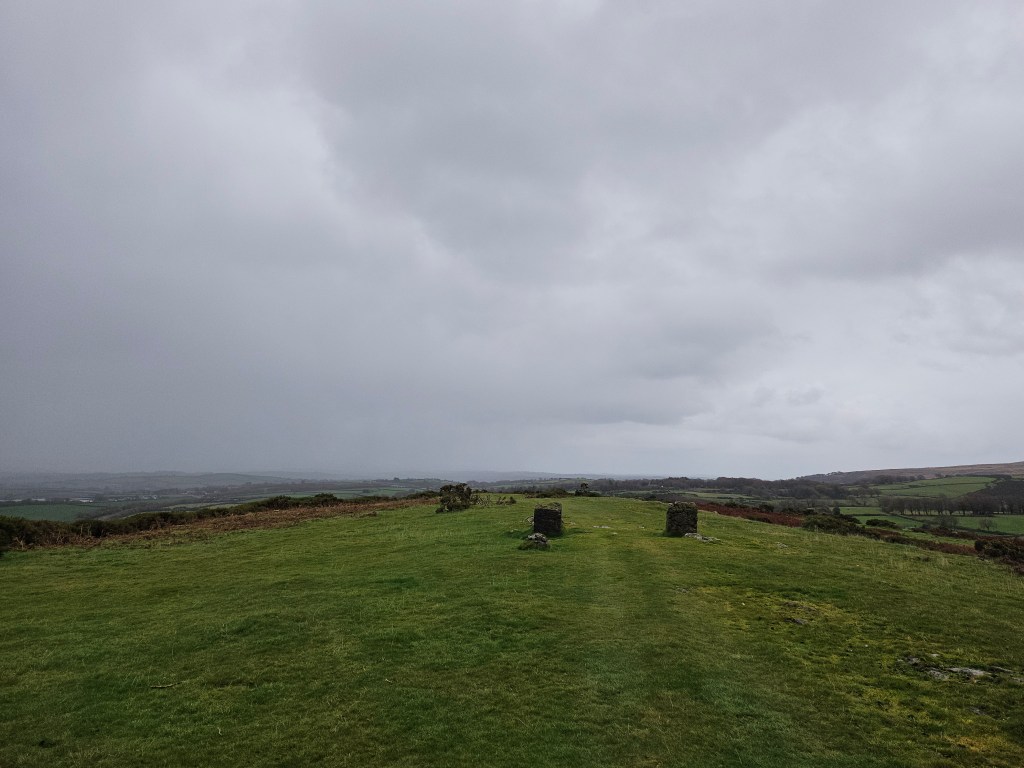
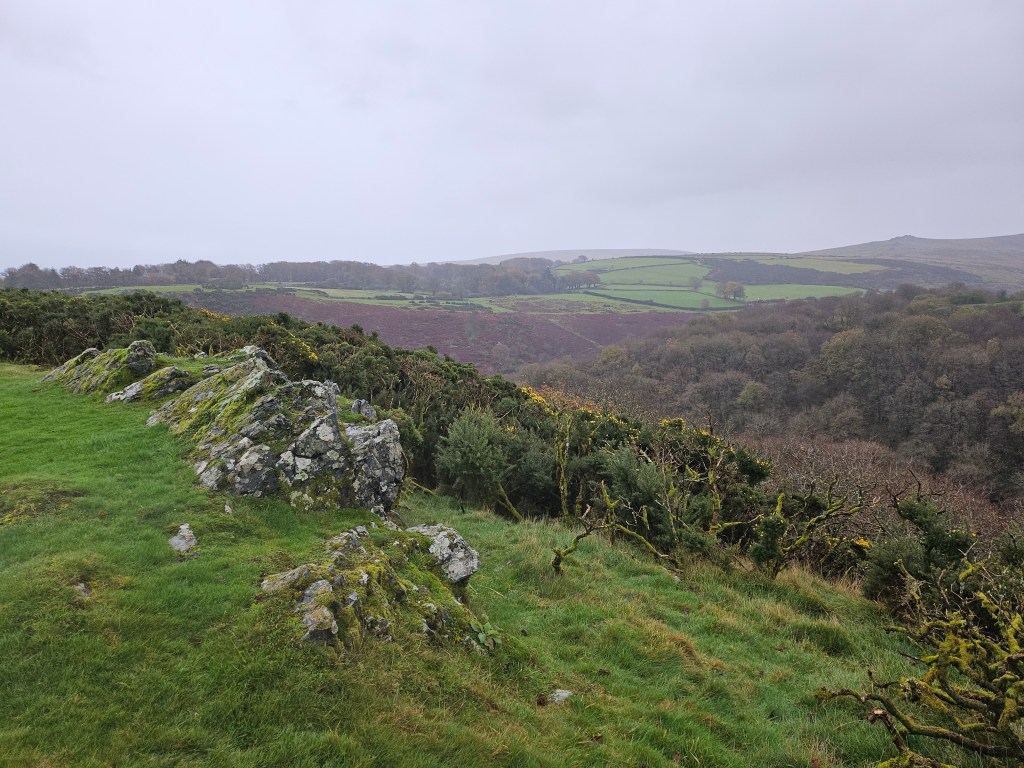
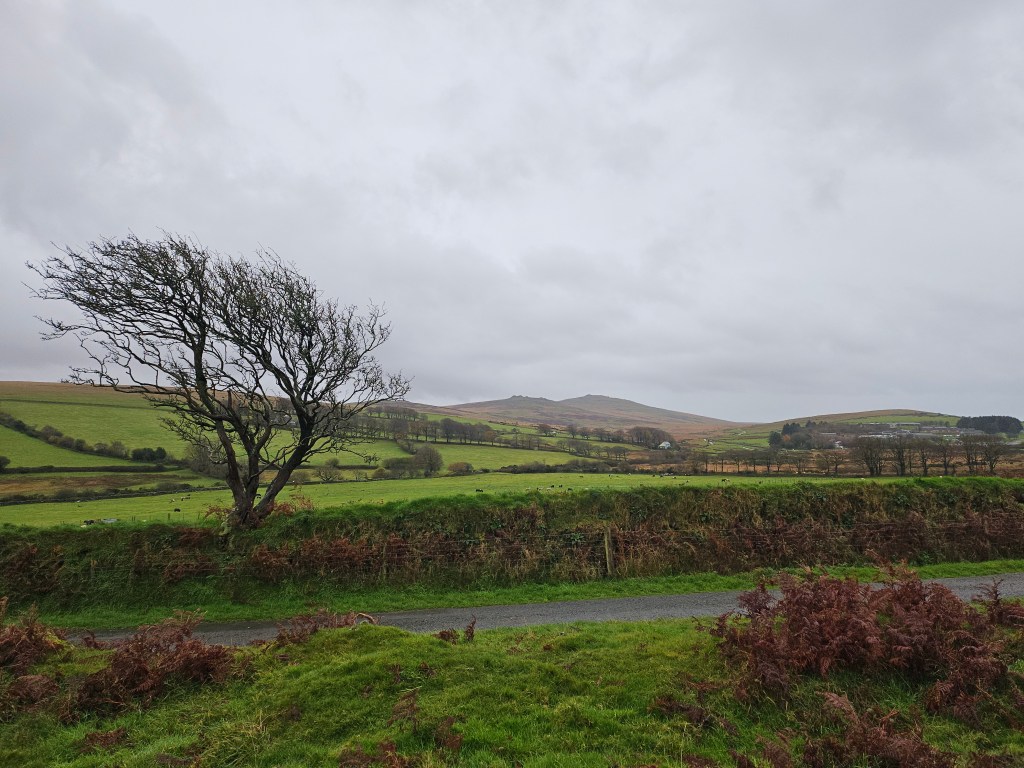
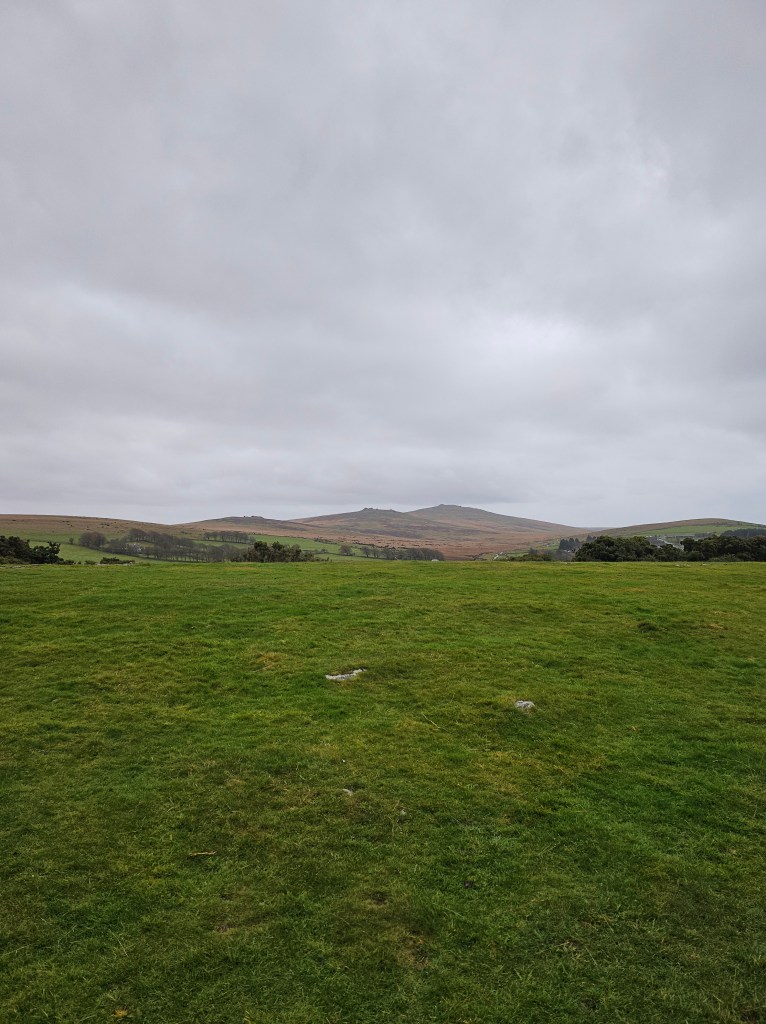
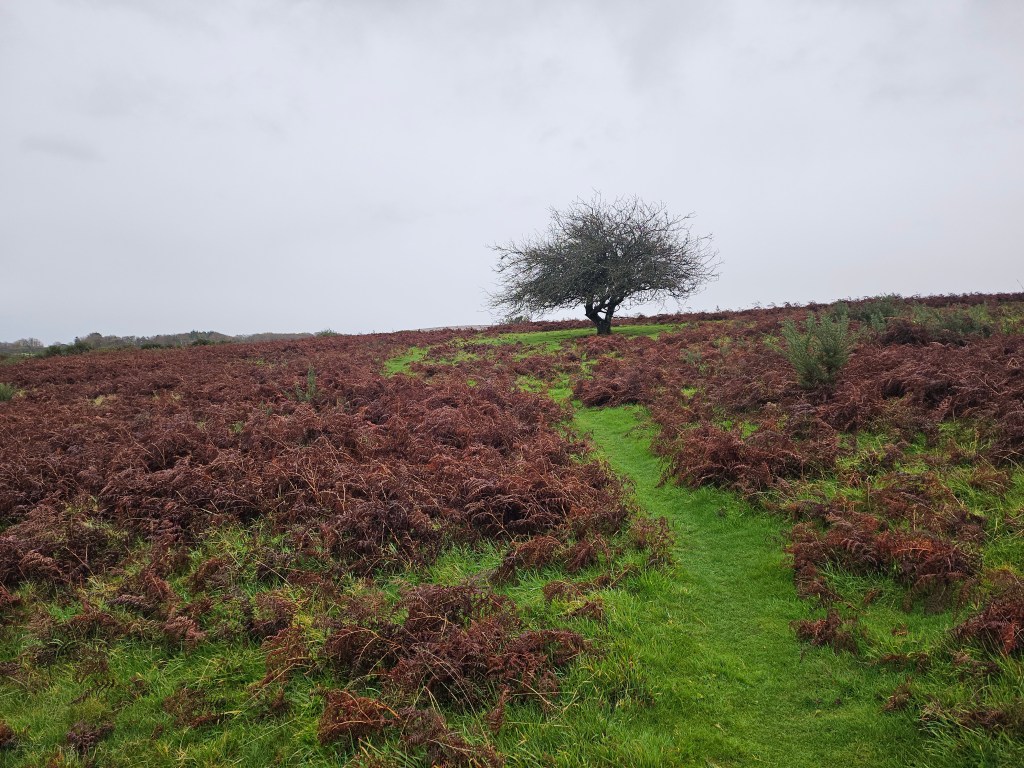
And what moors these were to walk! The classic imagery of Dartmoor, which was marvelously illustrated in the original Hound of the Baskervilles, lies further to the south. Dartmoor is defined by its tors, the granite rock formations that push out of the ground. They are beloved and very carefully mapped – you can find a full database of them here. At the very northern edge of the park, where it meets Okehampton, the moors are still home to some greenery and a lot of ferns, though if you look carefully you can see the rocks peeking out of the landscape. Resolving that it would be hard to defend my dissertation this winter if I was still trapped wandering the English countryside, I did not venture so far into the park as to see any of the famous rock formations. But all the same you could sense, even at the edges, the bleakness of the moors, and their strange appeal. Watson writes to Holmes about it in one of his more poetic moments, even as he admits that Holmes has no interest in such things:
“The longer one stays here the more does the spirit of the moor sink into one’s soul, its vastness, and also its grim charm. When you are once out upon its bosom you have left all traces of modern England behind you, but, on the other hand, you are conscious of the homes and the work of the prehistoric people…”
Dartmoor has been home to human beings since the late Neolithic Age, and it has the largest concentration of Bronze Age remains anywhere in the United Kingdom. What we now know, though Watson did not, is that the climate was milder then and largely forested – the bleak, sparse moors of today, which seem fitting only for sheep and ponies, evolved as a result of a climate shift several thousand years later. Even in the greener sections, however, I think Watson was right: it sinks into your soul, a little. There is something profound about such a wild and open space that was once home to the human race, abandoned for many ages, and now sees life occupy it once more. I returned home covered in mud, deep in thought, and strangely reverent. I did not see a daemonic hound, but you can’t have everything.
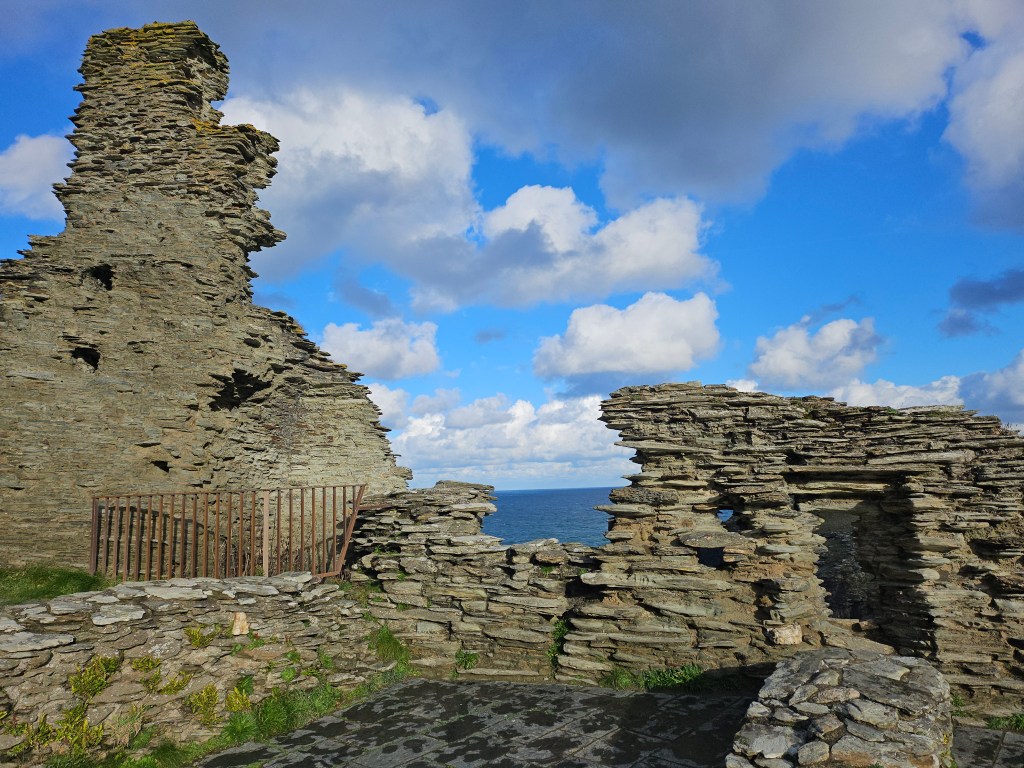
I took my two buses with their hour layover to get out to Tintagel the next morning. In favor of the buses, they were both almost mystical-looking routes, the latter with sweeping views of the sea, and I thought there was an awful lot to be said for letting the bus driver handle the hairpin turns and leaving you free to admire the scenery. (Thanks to a fare cap, the whole round trip also cost a grand total of £8, which is less than it costs the average New Yorker to get to JFK on the subway). From the village it was a short walk down to the castle, or what’s left of it. You don’t go to Tintagel for the ruins, I don’t think – there are ruined castles all over the country (including in Okehampton!) and many are in better condition. No—I think it is fair to say that you go for the myth.
There’s been a bit of controversy around Tintagel in recent years, as Cornish historians have protested the “Disneyfication” of the site by the English Heritage Trust. (One must understand “Disneyfication” in British terms here: exactly one statue has been installed, one carving has been made, and there were briefly plans to build a bridge named after Arthur’s sword Excalibur, which were ultimately scrapped in favor of another design. If this were America, the place would have banners every two feet, costumes for people to change into, at least one horse running around, and possibly a full-time herald who plays a trumpet every time a visitor walks in). Richard of Cornwall, the thirteenth century Earl who built Tintagel Castle, was not Cornish himself, and so there was an outcry that by leaning into the possible hype around King Arthur, the site is erasing Cornish history. And there is real Cornish history to point to here: archaeologists have turned up Mediterranean goods dating from the 5th to 7th centuries, evidence that during the age of the Cornish kingdom, Tintagel was a mighty stronghold indeed. The argument, particularly from Cornish nationalists, is that this early history should be centered above the idea of what later Englishmen thought the site represented – after all, the 1200s are pretty late in the span of English history.
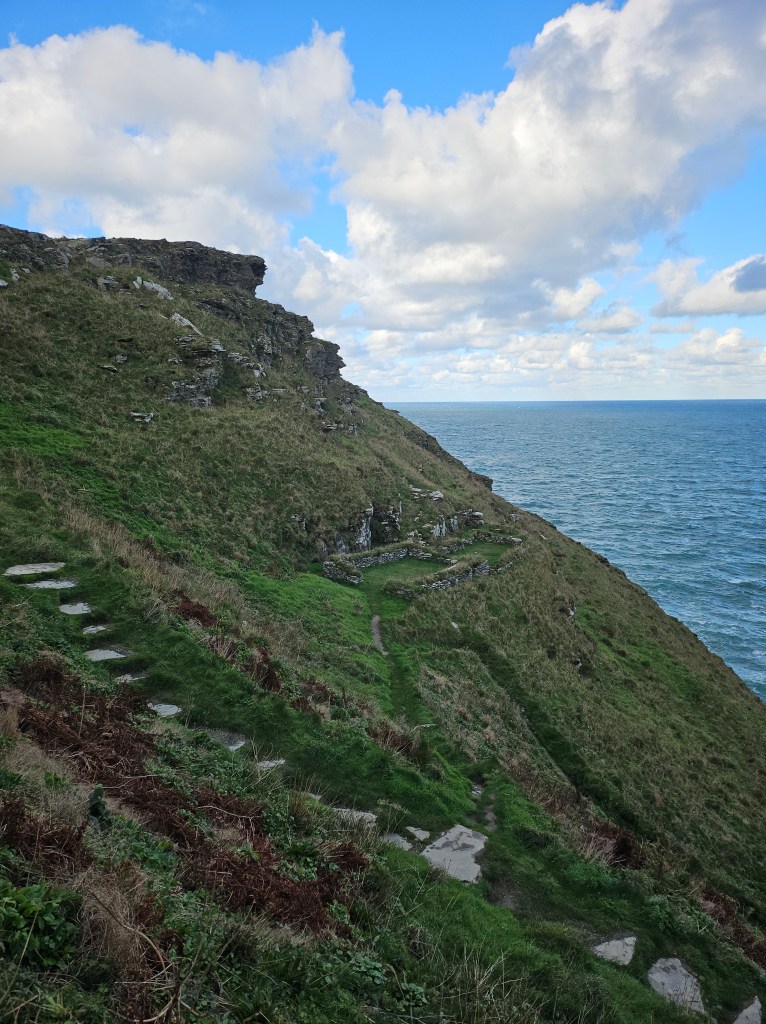

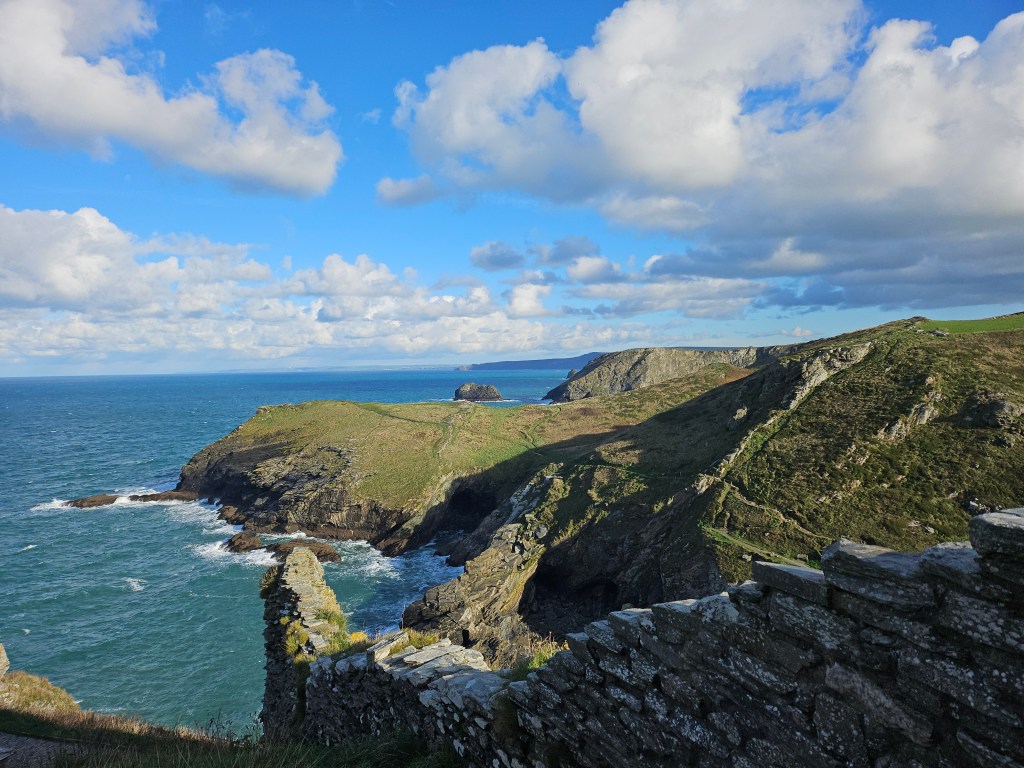
The statue that sparked this debate is the 8-foot-tall “Gallos” (the Cornish word for “power”), who stands at the very top of the island. (Tintagel was once fully attached to the mainland, but the rock has since eroded, and now when you visit you cross the brand-new bridge. Before 2019, people had to hike all the way up and down the stairs to a crossing point—a point in favor of the English Heritage Trust, I think). I will admit, being a scholar of monuments, that it was a photo of this statue that inspired me to visit Tintagel in the first place. It’s not specifically a monument to King Arthur, but it is hard not to imagine him, rex quondam rexque futurus, looking across the England he once ruled and waiting to one day take up his mantle once more. “I for one,” wrote T. H. White in 1942, “hope that some day, when not only England but the World has need of them, and when it is ready to listen to reason, if it ever is, they will issue from their rath in joy and power: and then, perhaps, they will give us happiness in the world once more and chivalry, and the old mediaeval blessing of a certain simple people—who tried, at any rate, in their own small way, to still the ancient brutal dream of Attila the Hun.”

King Arthur is not a happy tale, as anyone who has read White or Tennyson or any of the other thousands of retellings knows. Perhaps for this reason I reached for White’s retelling in the immediate aftermath of both Trump elections – now and in 2016. In 2016 I looked to White for his historical context. Writing during World War II (and a lifelong misanthrope), he despaired of humanity, and yet Britain emerged from that war with the greater enemy vanquished, and White was able to summon some hope for the future despite his bleak view of human nature. This time, I reached for it because it is sad, and because, as Arthur learns at great cost, many are not interested in the rules of what is Right, and sometimes those are the forces that prevail. Yet in the Book of Merlyn, White’s posthumously published fifth book in the Once and Future King quartet, White anticipates the feeling of futility we all might have at knowing the failure of Arthur’s experiment, and he responds quietly through the mouthpiece of Merlyn with a litany of all those people, over the course of fifteen hundred years, who have written about King Arthur and his Knights of the Round Table and their quest to make the world a little more just. Arthur may not feel that he has achieved anything at all within his lifetime, Merlyn acknowledges. But he has left a legacy that will give people hope. Eight years ago, I hoped that we were in a more decisive moment, where a particular kind of definitive victory might be won. Now, seeing as we are in fact in the midst of a long battle, there is a different kind of comfort in knowing that even when victory is fleeting, stories remain with us.
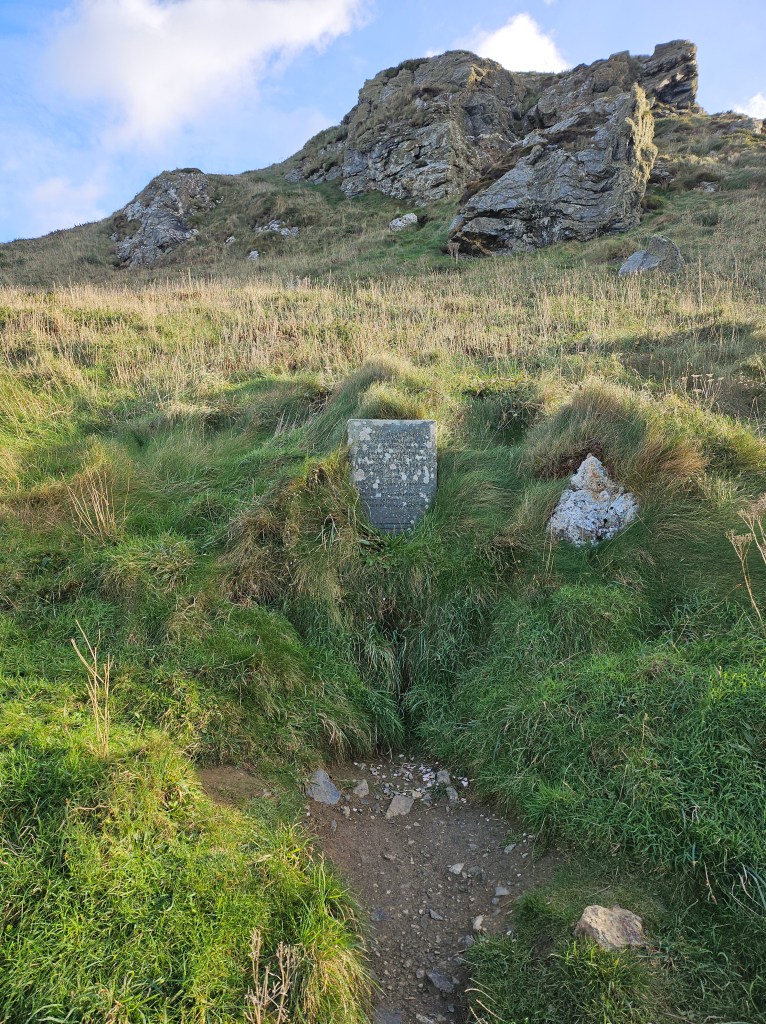
I am not an expert in Cornish history, nor am I inclined to disagree with pretty much any accusation leveled at one of the world’s greatest empires about how they’re being too, well, imperial. Still, I wondered about Tintagel, and about its purpose. The land next to the castle belongs to the National Trust, another heritage organization, and when I was hiking up to the top of the neighboring cliff I noticed a small stone:
THIS HEADLAND
THE PROPERTY OF THE NATIONAL TRUST
FOR PLACES OF HISTORIC INTEREST AND NATURAL BEAUTY
PURCHASED IN 1896 BY PUBLIC SUBSCRIPTION
FOR THE USE AND ENJOYMENT OF THE NATION
–
HARD BY WAS GREAT TINTAGEL’S TABLE ROUND
AND THERE OF OLD THE FLOWER OF ARTHUR’S KNIGHTS
MADE FAIR BEGINNING OF A NOBLER TIME
The quote is from yet another British author who put his skills to honoring King Arthur: Thomas Hardy. And no, it does not address the Cornish claim to this land. But the stone itself is small and simple, obscured and weathered by the landscape, and its words dedicate Arthur’s story to a nation, and perhaps even to those people like me who have come from even further afield. We need these myths, I think. We need models to look to and to remember, even when they are not true.

I had planned to leave Devon the following morning, but fate intervened in the most classically British of forms: the weather. I had noticed the snow when I got up, but having spent most of my recent winters in Minnesota, Chicago, or Canada, the entirety of my reaction had been to move my chair closer to the window and wonder absently if I could finish my current job application quickly enough to still have time for a walk before my train. But Devon is (mercifully, in many ways!) not Minnesota. It was probably only about 4 inches, but the snow came heavy and fast, and one day later there are still no trains in or out, and the buses are still stranded. (Apparently, there are actually a lot of places the National Rail service doesn’t serve in certain climates). Perhaps the answer to all my soul-searching is just that I should live here? As I write this, rain is falling fast on all the freshly made ice, which makes staying a whole lot easier than going. Stay tuned!
Luckily, I am a winter person, so I used the extra time yesterday to revisit the moor, which now looked less like the domain of a spectral hound and more like the sort of place you’d find Mr. Tumnus. Back down in Okehampton that evening, I heard residents talking in the grocery store about how if this was America, they’d have gotten the plows out straightaway and the whole area would be clear by now. This, I know from time on the East Coast (and occasionally Minnesota!), is also a myth. But I am hardly going to disabuse anyone of it.
The Hound of the Baskervilles is perhaps the most beloved of all the Holmes stories, and with good reason. The introduction to the copy I brought with me speculates that this is because there is a touch of supernatural to the affair. “One cannot always have the success for which one hopes,” Holmes shrugs at one point. “An investigator needs facts, and not legends or rumors.” But this is a lie that the great detective tells the criminal to throw him off the trail, and in this instance I think the author of this introduction is wrong. The Hound of the Baskervilles is great not because of its spectral monster, but because the villain behind it is entirely human. Monsters and legends can be manipulated to evil as well as good, as Holmes knows. Which is all the more reason that we must hold onto the ones that give us hope.
And besides, you never know. Hiking up for one last vista at Tintagel, I looked up to the rock high above me and saw – a gigantic hound! All right, it was an enormous black dog, and its masters followed behind it a moment later, but even so. Sometimes, if you’re open to it, the legends will find you.

 Much That Is Fair