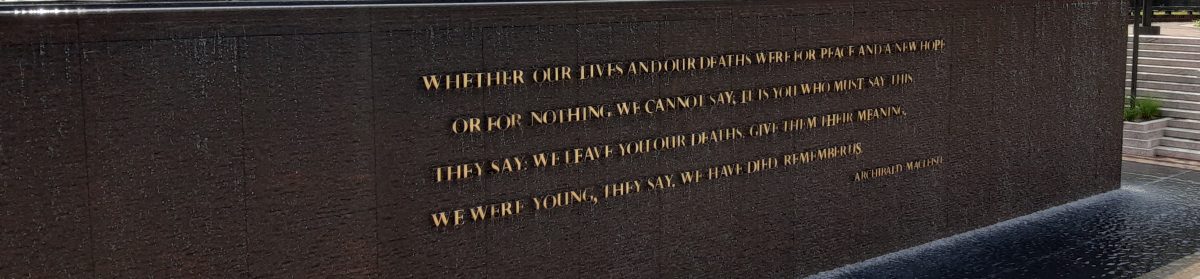
I have never bothered to conduct a survey, but I suspect that if you did, less than ten percent of the American population could reliably distinguish between the origins of Memorial Day and Veterans Day, rolled as they have been into one commemorative space. This is not your average American’s fault, really: maybe Memorial Day is a little more exciting, with the guaranteed three-day weekend and day off, but we have not marked them as distinct in any meaningful way for a long time now.
They are, however, quite distinct. Memorial Day is the older of the two, although it was once celebrated primarily on May 30, moving through the week like Veterans Day does. It was also reliably celebrated in only half the country until, at the very least, World War I, and in some places not until the 1990s. When it was known as Decoration Day, Memorial Day was a holiday to honor Union soldiers; states of the former Confederacy, in a rarely successful display of their commitment to states’ rights, selected different dates by state for Confederate Memorial Day. The death of Stonewall Jackson, May 10, was popular; so was the date of the Confederate surrender to William Tecumseh Sherman (April 26). Strangely, given their consummate fixation on defeat, no one selected April 9: the date of the surrender at Appomattox.
Veterans Day, meanwhile, renamed from Armistice Day after World War II and Korea suggested that one federal holiday per war was going to become a headache, was always our holiday of the 20th century wars: it takes its date from the end of World War I, and it offered a space in time that Union and Confederate sons and grandsons could agree on when they recognized military service in this country. Lately they’ve begun to slip into each other, and the most common distinction used nowadays is that Memorial Day is for the dead, while Veterans Day is for the living. Yet when I found myself free and on the road this Memorial Day, I did not go to a town known for its World War memorial or for some other recent conflict in which we have lost too many Americans. Instead, drawn almost in spite of myself, I went to Gettysburg.
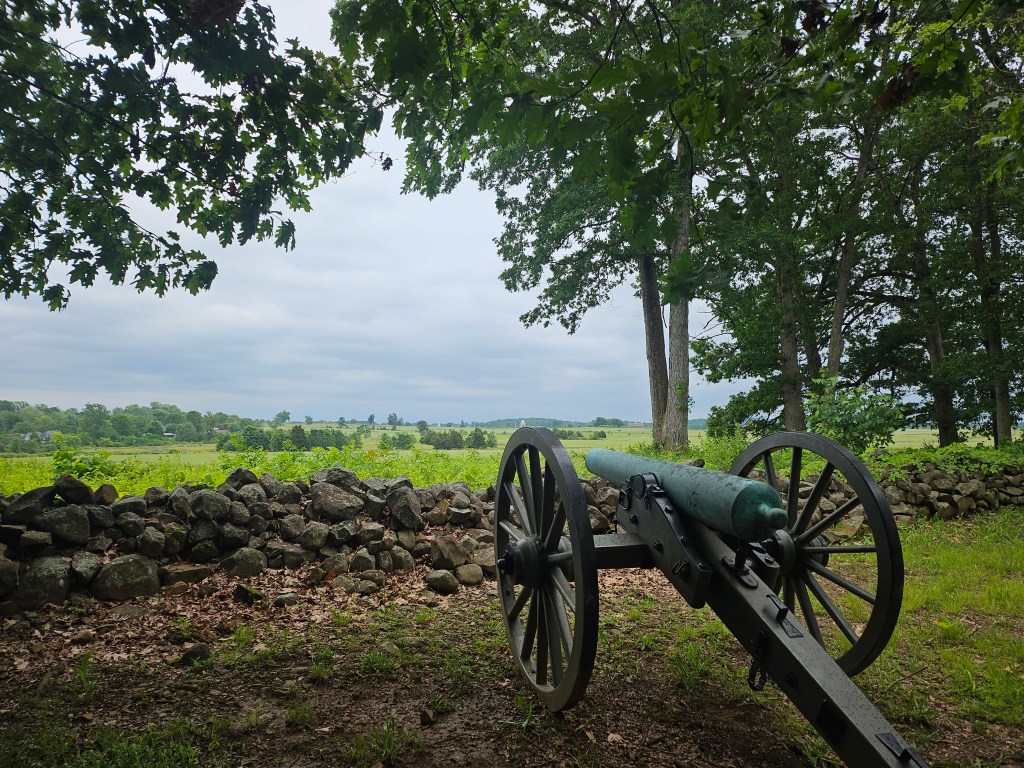
I have been to Gettysburg before – less than a year ago, even. But it is one of those places with an unending thrall, in part because it is deeply tragic and very nearly sacred, and in part, honestly, because it is so weird. Commemoration at places like Gettysburg forced the backlash in the 20th century against war memorials, because even when the American populace could not agree upon what might be a good way to honor our veterans, everyone agreed that setting up a statue every ten feet for every single regiment that engaged in a given battle was… not it. The rows and rows of monuments that line each major battle line are helpful, in a way, for someone who might want to visualize where the different armies were facing off – you can tell how far apart they were from where the other side’s monuments stick up in the distance. As a commemorative space, it fails utterly to communicate the horrors of war, the violence of July 1 to July 3, 1863, the bloodiest battle of the whole Civil War, which in turn remains to this day America’s deadliest military conflict. But it certainly communicates something about American memory.
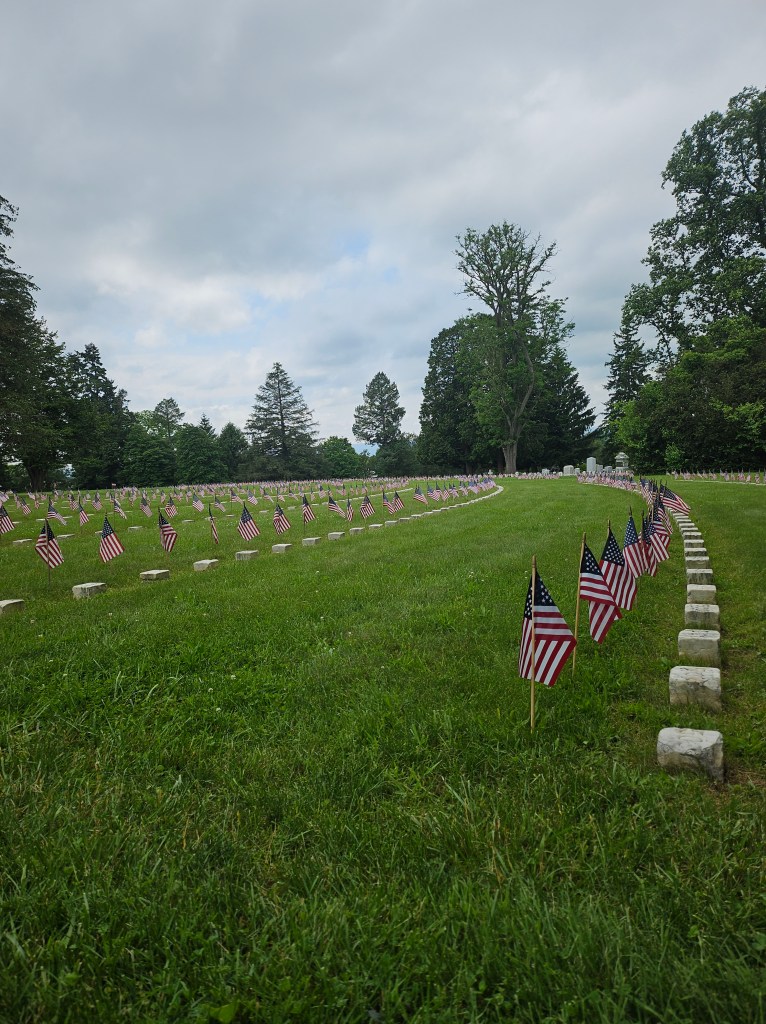
I was drawn there perhaps because even while it is representative of the single most fractured moment in American history, it is also a symbol of the Union that held, the Union that is all of our legacies now, even if those from the South may not wish to admit it. I was viciously pleased to note that while the Union statues had been ornamented with small flags to mark the holiday, the Confederate statues remained bare. Southerners very famously made Gettysburg into the apex of the Lost Cause mythology, the so-called “High Water Mark” of the war, but the fact remains that they are still Americans, first and foremost, no matter how much they might wish it otherwise. This is our history, North and South alike. In a country that seems to be constantly rupturing at the seams, drawing further and further apart, I suppose I came to Gettysburg in search of that shared past, in the hopes that it might still mean something.
I drove into town to see the Memorial Day parade in the early afternoon, figuring that here, at least, there’d probably be a crowd. Neighboring Carlisle, Pennsylvania is home to the U.S. Army War College, and there are always history buffs in town. While Gettysburg is nearly synonymous with the Civil War, Carlisle is rich with history from all eras of America’s past: George Washington surveyed his troops there before heading out to put down the Whiskey Rebellion; notables like Roger Taney and James Buchanan were alums of Carlisle’s Dickinson College, the first liberal arts college to be formed in the new United States. During the Civil War, the town was shelled (you can still see damage on some of the buildings); in the 1880s, Carlisle Indian School pioneered the residential school model for Indigenous Americans, one which ripped Indigenous children from their language, heritage, and homes for the sake of “Americanizing” them, leaving most torn from their tribes and deeply traumatized.
A rich and tortured history, one that is more immediately apparent because Carlisle is not famous the way that Gettysburg is famous. Yet Gettysburg has all those layers of history, too: before the war came, it was the home of Thaddeus Stevens, the Radical Republican whose abolitionist and pro-education advocacy helped shape post-Civil War America. It was in Gettysburg that President Woodrow Wilson proclaimed once and for all that the North and the South had reconciled, even as he was framing “reconciliation” in terms of banning Black Americans from holding integrated posts in the federal government. Gettysburg sent its men off to America’s other wars like any other town – but perhaps their memorials are a little smaller than average. After all, they know what an overload of monuments looks like.
Still, I was surprised to see how paltry the parade was – I was late, but I caught all of it, and it lasted all of ten minutes. Mostly it was aging veterans in Army Jeeps and trucks, including the last handful of World War II vets who are still with us, singled out for special recognition as a symbol of the war Americans are all supposed to agree on. I wondered whether they noticed the small size of the crowd, the sparse applause. It wasn’t really that the audience was unenthusiastic – just that there weren’t very many of them. With a free extra day on the weekend, it seemed like most people had somewhere else they wanted to be, and that for many people in the area, that place was the battlefield itself. In today’s America, perhaps wrestling with ghosts is a more appealing task than staring directly at our present.
Giving speeches at Gettysburg is a somewhat loaded affair, thanks to 272 words from that guy with a high-pitched voice and a Kentucky accent. I didn’t have high hopes for the memorial ceremony that followed at Gettysburg National Cemetery, but I went anyway. After all, the men buried there are not just from the Civil War – they range from World War I to Vietnam, and some of them are unwitting subjects in my research. Visiting their graves is the least that I owe them. On Decoration Day, graves were typically strewn with flowers, but the Jewish custom is always to leave stones at a gravesite. Throughout the ceremony, I wandered around, tracking down the few Jews in the cemetery and adding stones on top of their graves. I wondered if anyone else had noticed that underneath the carefully placed flags and manicured grass, the cemetery appears to be home to an outrageous number of wild strawberries.
The speeches reached me wherever I was in the cemetery, but it wouldn’t have mattered much if they hadn’t. Most speakers fell spectacularly, almost tragically short, including a pseudo-President Lincoln who had been hired to recite the Gettysburg Address. Most speakers did attempt to work in a reference to the original, but they echoed its words, and not its meaning. Speaker after speaker stumbled over the phrase “last full measure of devotion,” but no one mentioned what the speech had done. More amazing still was the gesture of “unity” they offered the crowd: as they lined up representatives of America’s different wars to honor with garlands, they included the Sons of the Confederate Veterans. I left after that – whatever past I was looking for, I was not going to find it there.
The real genius of the Gettysburg Address, as Garry Wills and others have noted, was that in that short span of words, Abraham Lincoln created a usable past for the war-weary American people, one which would allow them to take pride in their history while forging a different future, one that was based in historical interpretation, but not historical fact. “Our fathers brought forth on this continent a new nation, conceived in liberty, and dedicated to the proposition that all men are created equal” – all? We know from Thomas Jefferson’s own papers, where he created mathematical equations as he tried to determine how many generations it might take for his own children to birth white offspring, that he did not believe that line of the Declaration of Independence the way that Lincoln took it.
But Lincoln’s statement did not interpret what Jefferson had said as Jefferson believed it. Instead, Lincoln used the words as Lincoln had always interpreted them, well before he was president, well before the war had begun. A country founded on a principle of equality could not be a country that kept people in bondage. A country founded on the principle of equality would not be a country that kept people in bondage, and it was tearing itself to pieces to ensure that it would live up to the ideals that founded it – to bring forth a new birth of freedom, if you will. This was a usable past, one that could give meaning to our history and help shape our future.
We in America have tried, repeatedly, these last thirty years or so, to make respect for our military and for their sacrifice a line that brings together all Americans, even as our country continues to tear itself apart. The dwindling lines at Memorial Day parades and the small crowd at the cemetery suggest that if that tactic ever worked, it is not working now. Half of our nation is seeking desperately to reclaim a past that never was – to “take America back” to some mythic version of our history where the Carlisle Indian School never existed, and where Thaddeus Stevens did not need to advocate for an end to slavery. This approach will never lead us forward. But there are many, too, who cannot decide how to accept the wreck and ruin of our history, to see what we were plainly and yet find something redeemable in this country. But we must use our past, for it will not leave us. Those endless graves hold terrible horrors, and terrible truths. Sometimes, they also hold strawberries.
Lincoln realized what most of us do not: that we are stuck with the past that we have, and that its basic facts cannot be changed. There was certainly horror arrayed in abundance before him when he spoke at Gettysburg. But his choice was to acknowledge that horror and use the truth of it to make something for the future. What might we accomplish if we took up that task ourselves?

 Much That Is Fair