One of the curses of being a graduate student is that you are completely unbound from the normal tethers that anchor people to reality, like working hours and HR offices and regular, reliable wages. It is a challenge that has both professional and personal ramifications – is well documented, these days, the kinds of abuses that graduate students are vulnerable in the academy, but it is quite possible to drive yourself mad in a world without deadlines, job prospects, or any clear sense of what you’re doing most of the time. To finish in one piece, you must find your own way of handling the constant uncertainty.
I have coped with this pressure, for better or worse, by leaning into it, which gives me the (mostly false) illusion that I have some control over what I’m doing and what will happen to me when I graduate. Most recently, this led me north, all the way to our Canadian neighbors, where I spent a brief period this winter visiting Quebec City and their Winter Carnaval while working on writing a dissertation chapter.
“Why were you there?” Many people have asked me this question, and they were right to do so. When I say I am an American historian, I mean that I am a historian of the United States, and (despite what many of the Founding Fathers wanted to believe, and the generation of the War of 1812 tried desperately to make reality) Canada is not the United States. Americans served in the Canadian Expeditionary Forces in the First World War, and in fact that does factor into my research, but the records of that experience are in Ottawa, not Quebec, where a tense relationship with Canada’s federal government led many Quebecois to resist the draft altogether. (I noted, when I was there, that there is a street named for Joseph Joffre, the Commander-in-Chief of the French Army for the first two years of WWI, but none for any of Britain’s comparable generals). All told I know very little about the history of Canada, and to make matters worse, I do not speak French.
All the same, I had a whole host of reasons to visit Quebec, at least for a short trip. Since last March, when I gave up my apartment to conduct my doctoral research in earnest, I have been on the road, running through archives and past monuments to collect as much data as I can. (Someday, with the help of the new unions, it may be possible for graduate students to both maintain a permanent residence and pursue wide-ranging research; unfortunately, it does not appear that that day will come soon enough to help me much). When it came to my research, the fact that I had absolutely no reason to be in Quebec was the center of its appeal. Dissertation writing requires total focus, and thus I thought that a region rich in its own history, a history that had nothing to do with mine, might provide a useful contrast.
That history is indeed largely unrelated to my research, but it is deeply valuable, too. It is good for Americans in particular, I think, to remember that the world exists beyond our borders, and that it has much to teach us. Quebec City features prominently in the early colonial history of the wider Americas, a topic which I frequently teach, and it is also an interesting case study in how things might have gone very differently for us here in the United States. Most people forget now (or never knew) how deeply concerned President Jefferson and others were with admitting Louisiana to the Union in the early nineteenth century – they were French, after all, and worse, they were Catholics. We often see our history clearer when we are removed from it, or when we are provided with counterexamples. In Louisiana, those colonists eventually shed much of their local history to become a larger part of the American project. In Quebec, they did not, and the modern province offers a counter-history to the many parts of our country that were once significantly influenced by French colonizers.
I also came North because I am a helpless, unreformable lover of winter, and Quebec suffers from the kind of winter that will make you think that 20 degrees Fahrenheit is T-shirt weather. Winter is a simple season in some ways, in that it lays bare the essential things one needs for survival. But it also reveals some of life’s strange paradoxes. It is much more dangerous to go downhill than uphill when there is ice on the ground, I have learned. And 10 degrees is a much safer temperature to walk on snow than when it is only barely freezing outside, however much warmer it might be. What makes sense in other seasons does not always make sense in winter.
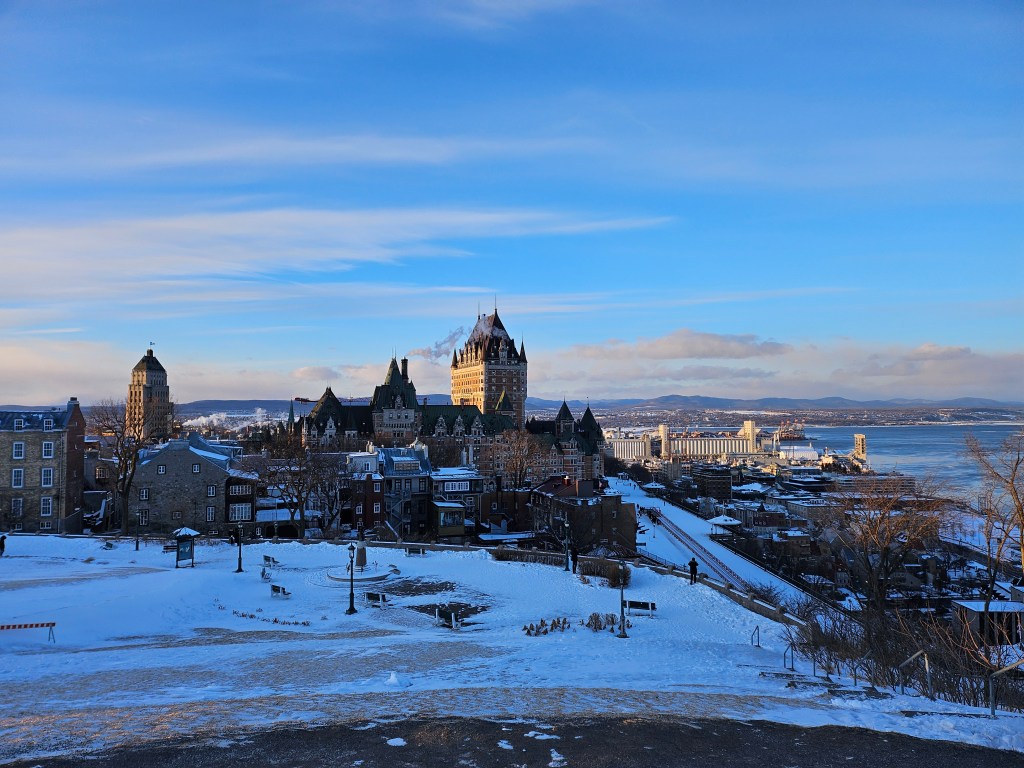
I love winter, too, because it is beautiful, and there are few places in the world where it is more beautiful than Quebec City. The city is not only frozen in ice, it is frozen in time: whereas Quebec’s largest city, Montreal, has preserved a small section of its historic city and set about building skyscrapers and modern neighborhoods for the rest, Quebec’s heart remains a place where cars look out of place but horses fit right in. It is the only walled city north of Mexico in North America, and it preserves the history at the heart of Quebec: the loss of French Canada to England in 1759, during the Seven Years War. Often called the French and Indian War here in the United States, the name is misleading – the war actually set the French and their Indigenous allies against the British. The war was catastrophic for the French, who in one swoop lost their foothold across the New World, from the great frozen plains of Canada to swampy Louisiana. The loss of Canada came on September 13, 1759, when the British ended their siege of Quebec City with a surprise attack on the Plains of Abraham (so named for the farmer who owned the fields) outside the walled city. The French lost the territory that would become Canada in a battle that lasted only thirty minutes.
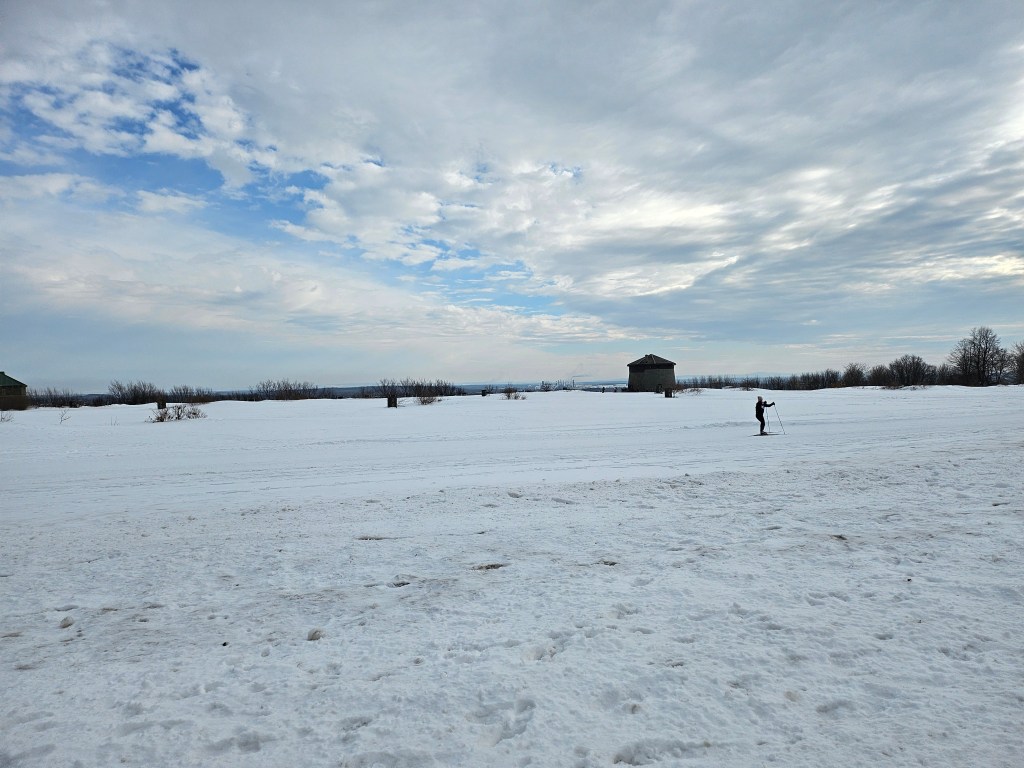
The battle, and its consequences, continue to define Quebec today. The Plains of Abraham were preserved as a public park in the early 20th century, and cannons continue to line the Plains and most of the city walls. (In the nineteenth century, they were even called upon to fight plague: during a cholera epidemic the cannons were repeatedly fired to help ‘clear the air,’ as it was believed that the smoke might help treat patients). The Citadel at the head of the Plains is part-active fort, part-museum, and the city itself pays fierce attention to its French heritage, often ignoring the English history that came after.
This is particularly apparent in who is honored in the city’s memorial landscape. The crowning centerpiece of monuments in the city (next to the legendary Château Frontenac) goes to Samuel de Champlain, the city’s French founder; other nearby monuments honor other first French settlers (including, to my amusement, the city’s first pharmacist). On the Plains of Abraham themselves stands a replica of the Joan of Arc statue that graces New York City’s Riverside Park. While in New York and elsewhere in the United States copies of the statue have been put to a variety of only vaguely-French-related purposes (another replica in Lexington, MA, doubles as a World War I memorial), in Quebec she is there to honor a French military victory over the English – even if that victory occurred in 1429, not 1759. A monument to the victorious English General James Wolfe, who led the siege of Quebec only to die on the Plains in battle, has been destroyed 5 different times in Quebecois history, most recently in 1963, a decade when Quebec’s separatist movement repeatedly turned violent.
So perhaps I was drawn to Quebec, too, because while it seems that history here has frozen, it is frozen in the same way that rivers freeze in winter: seemingly still, but constantly moving and reforming under the surface. Quebec’s provincial motto is Je me souviens, or “I remember” – what could be more alluring to a scholar of memory? Officially no one has confirmed what it is the Quebecois are remembering, but it can be seen throughout the city’s history and its present. “Having a French accent here is worse than speaking in English,” one recent French immigrant told me when I asked about her experiences there. Why? “They think we abandoned them.” (In 1759, yes). In 2014, the city finished remodeling work one of the historic local churches, remaking it into a gorgeous public library that sits in the center of the Old City. A beautiful gesture – but hard to ignore the fact that sitting across the street from the church-turned-public-(French!)-library is the privately-run Morrin Centre, an institution dedicated to the history of Quebec’s English speakers and their culture, which is housed in the city’s former jail.
Like most places where Winter is always spelled with a capital W (or H, in this case), the Quebecois approach the season with two key tools: a serious, careful assessment of what is needed to make it through, and a treasured sense of good humor. You can find the sense of responsibility all over Quebec City, from the sturdy, sensible winter coats to the fires kept burning at select outdoor sites, so that people can visit outdoors safely. Most prominently, you can find it in the roof snow removers: the men and women who spend the winter rappelling up and down the sides of the buildings in Old Quebec, breaking up the snow and ice, and shoveling it down to the ground, all so that it will not melt and strike an unsuspecting passerby. Such falling snow can be deadly, and is not something to joke about – Louis Hébert, the famous first French pharmacist to settle in the city in 1617, lasted only 10 years before succumbing to injuries sustained from a bad fall on a patch of ice.
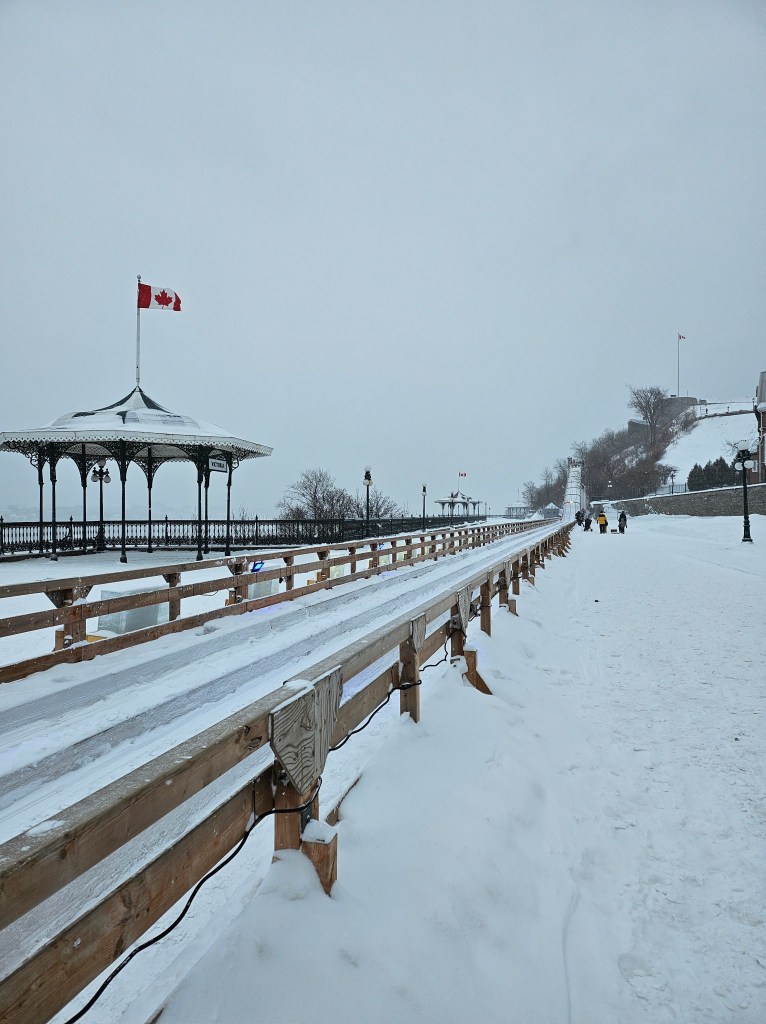
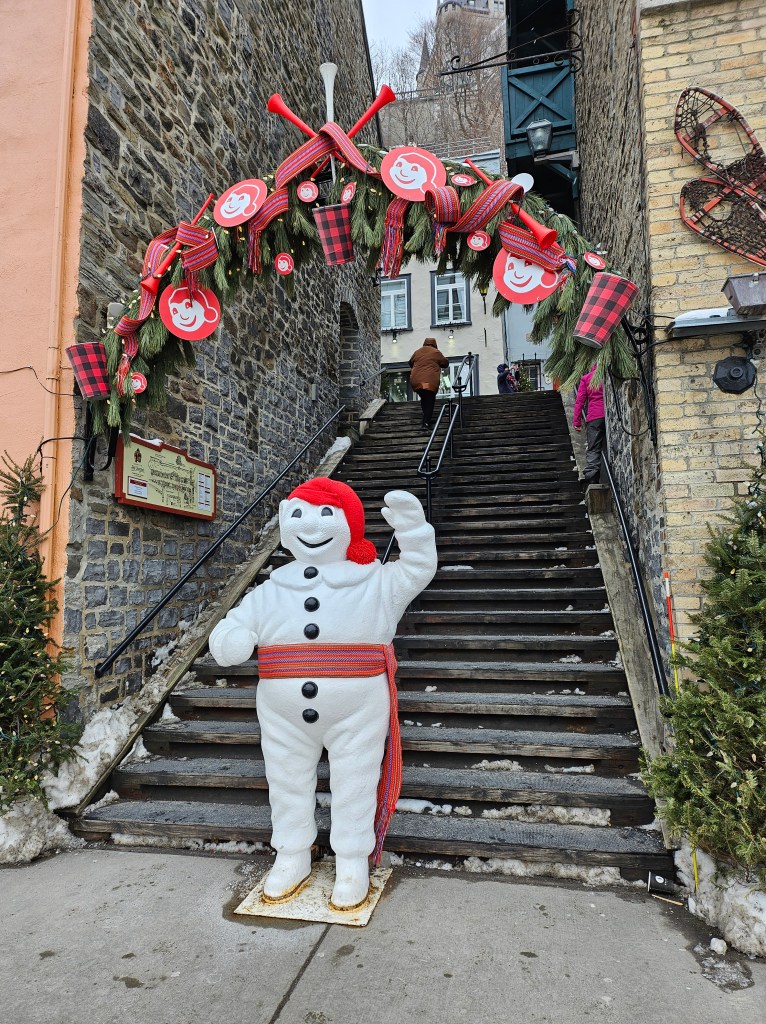
On the humor side, there is the third reason why I wanted to visit Quebec specifically in February and the reason that I would encourage any winter haters to visit Quebec in February, too: the Winter Carnaval, a tradition with roots in the Catholic Carnaval celebrations around the world but uniquely adapted for Quebec’s unforgiving climate. Probably the biggest event is the ice canoe race, a practice hailing from the days of the First Nations, who used the technique to cross the St. Lawrence when it had not completely frozen over (one canoes in the open water, then uses one leg out of the canoe to propel it across patches of rotten ice). Instead of daytime parades, Quebec offers the Night Parade, held in subzero temperatures but with the hallmark extravagant floats and exuberant music. Other mainstays include a garden of ice sculptures and an ice palace, the home of Bonhomme, the festival’s host. Bonhomme, short for the French bonhomme de neige, or a snowman, is (according to Carnaval lore) reborn on a snowflake each year to take the form of a portly, 7-foot Quebecois snowman whose only purpose in life is to make sure that everyone is having a good time. Statues of him are placed at all major Carnaval events, with a larger-than-life, multi-ton statue standing outside of Quebec’s Parliament Building, but a live Bonhomme also makes special appearances at certain events, and spotting him is not unlike seeing royalty.
With its ice slides, parades, toboggans, and snowman ambassador, some might be tempted to see the Carnaval as a child’s space. Those are the people who do not know how to have fun. Throughout the Carnaval, I was delighted to see the adults (of all ages!) lining up to try going down the ice slide or the toboggan slope, running after Bonhomme to say hello, and marveling at the festival and the city with what can only be described, really, as childlike wonder. So often we think of winter as something to be endured, something that we must survive – so much so that Margaret Atwood, one of Canada’s greatest ambassadors to the world, once described the central theme of Canadian literature as “survival.” “There is a sense in Canadian literature that the true and only season here is winter: the others are either preludes to it or mirages concealing it,” she wrote. How marvelous to think that that central season could be something we treasure and anticipate, rather than a looming sense of doom.
There is no such thing as a place without historical problems – here as in most of North America, the contribution of the First Nations to the creation of what would one day become Canada is relegated to a whisper. A sense of wonder holds Quebec steadily in its thrall, but that wonder is tinged with a lingering unease for many, me included: how many Carnavals, I wondered, would we see in this warming century? In the years since I first read the Ojibwe author Louise Erdrich’s Future Home of the Living God, I have heard her voice in the back of my head every time I see snow fall: “Where will you be, my darling,” the main character asks her unborn daughter, “the last time it snows on Earth?” The last two days of the Carnaval this year, several events were cancelled for attendee safety: a thaw had set in, rendering many of the ice structures in danger of collapse. One that closed was the Ice Palace, in which I had seen a panel with Bonhomme painted on it cheering, “Sauvons la planète, savouns mon Carnaval!” Save the planet, save my Carnaval.
And indeed, although we motivate ourselves these days through our outrage and our despair, although there are so many reasons why we continue to desperately need winter as a season, if I had to give a reason for it to be saved, I would save winter for the wonder of Quebec. To see what human beings can do, when faced with nature’s adversity, is a balm for our souls as well as for our planet. How much more might we accomplish in the coming years if instead of giving into despair, we approached it as the Quebecois approach winter: with a serious, careful assessment of what will need to be done, and a sturdy sense of good humor?
I have since returned to properly work-related travel, and that will keep me on the road for at least another three months, maybe all the way until my dissertation is fully written and ready for defense. But I will remember the winter, just the same – the ice and the cold, and above all, the wonder. There is so much to be angry and sad about in this broken world. But there is much that is fair, too.


 Much That Is Fair