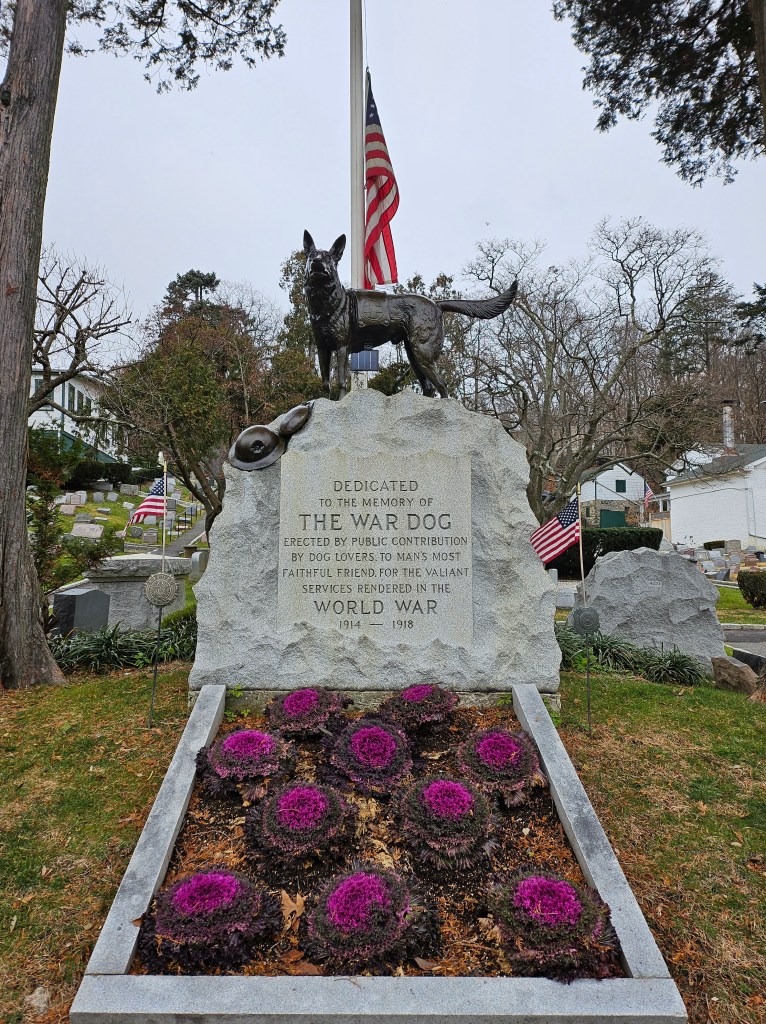
Hartsdale, New York is home to one of the country’s more eccentric pieces of history: the nation’s oldest, largest, and (in their own words) “most prestigious” pet cemetery. Founded in 1896 when a local doctor gave his friend permission to bury her beloved dog in his apple orchard, it is now the final resting place of thousands of animals, mostly dogs and cats.
I first learned about it as I searched the state for World War memorials: an early memorial in the cemetery, named the War Dog, is dedicated “by dog lovers to man’s most faithful friend, for the valiant services rendered in the World War, 1914 – 1918.” The staggering human cost of World War I often hides the toll it took on animals and on nature, but it too is nearly beyond imagining. After the war, veterans of the Great War estimated a soldier’s life expectancy on the Western Front to be three to six months. The life expectancy of a horse was two weeks.
And more animals found themselves on the war front than one might initially guess. While horses and dogs and pigeons were used on the Western Front and elsewhere for practical purposes, they and other animals served an additional purpose: comfort and cheer in dark times. Units adopted dogs and cats alike to trawl their trenches for rats and to curl up with them at night. Rarer animals, too, found themselves called to war as mascots and icons of national pride: a famous photo that never fails to amaze me shows an Australian soldier in front of the pyramids of Giza, holding the face of his pet kangaroo.
Although they are few and far between, the War Dog is not the only memorial to the animals of the First World War in the United States. In the war’s aftermath, Peavey Fountain, a local drinking fountain for horses in Minneapolis, was rededicated to the many horses killed in action as part of the 151st Artillery, a mostly Minnesotan unit. Directly inside the Massachusetts State House a plaque honors “the memory of the horses, dogs and other animals whose faithful service, whose sufferings, and whose death were part of the price paid in the Great World War 1914 – 1919, waged in behalf of the liberties of mankind.” The memorials have always struck me as deeply poignant, yet somehow ethically thorny. Human life suffers so terribly in wartime – why are we making a choice to honor a dog instead of a soldier? And yet, how can we do anything less when we got them involved in the first place?
Then this fall, Ozma, our family cat, began to fail, and suddenly I was thinking very differently.
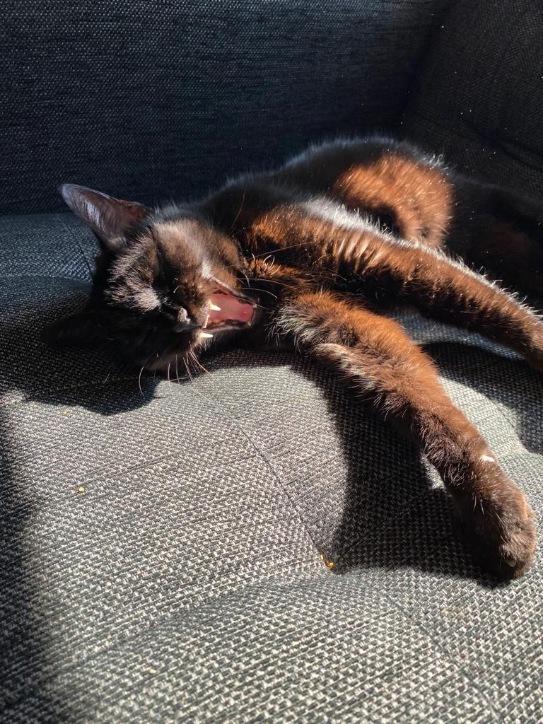
We got Ozma when I was thirteen and she just barely an adult at one year old, after a dramatic winter when the house was plagued with an endless parade of mice. She wasn’t a very good mouser, but her presence kept them away all the same. Her real talent, however, was keeping the family entertained: falling off things, yowling to interrupt our phone and Zoom calls, curling up to next you but facing away so that you knew she didn’t care that much, the usual cat things.
The next spring my sister came down with whooping cough, the disease that first taught me that just because we have a vaccine for something does not mean you can let your guard down in the face of illness. It stretched on and on for a terrible five-month period, with jags that kept her up coughing in the middle of the night for hours. The cat, miraculously, could make her smile – and when, at one point, I took to sleeping in the basement to get away from the nightly sounds of misery, the cat’s antics were about all that kept me amused, too. We cherished her as the family ‘entertainment center’ from her arrival until this morning, when, at the age of sixteen, she left us quietly in her sleep.
The time had come, I decided, to visit Hartsdale.
Hartsdale’s pet cemetery is not the cemetery it’s really known for: that’s Ferncliff Cemetery, about three miles on, and the resting site of many celebrities, including James Baldwin, Judy Garland, and Malcolm X. But the pet cemetery is perhaps a deeper testament to our relationship with life and loss. The War Dog is crammed in alongside thousands of memorial plaques and stones, all celebrating pets who were deeply loved. “Dot. October 28, 1916 – July 15, 1929. She lived to love.” “Dobie. 1981 – 1996. We love you.” “Silver Prince. Our beloved Persian cat. 1907 – 1923.” Some are marked with crosses or stars of David, like human graves. Perhaps it is not so surprising that the sentiments across the cemetery are so uniform across time – we have after all been burying pets at least since the Egyptians mummified their cats, a practice which we all thought Ozma would have approved of. Yet to see so much love and grief packed in such a tiny space was oddly moving.
Tonight is the first night of Chanukah, a time when we are supposed to celebrate miracles. It has not been a very miraculous year. Three years ago, the first rounds of the COVID-19 vaccines were administered during Chanukah, and many friends I knew felt a whole new meaning arise from the phrase etched on our dreidels: nes gadol hayah sham, a great miracle happened there. Truly, I remember thinking, we live in an age of miracles.
Now, three years on and with new tragedies constantly spilling onto our shores, those miracles too are beginning to feel like memories of ancient history. Instead, loss has come in all shapes and sizes: in the senseless slaughter of young children and the elderly, in national schisms and fractures in our local communities, anger and hurt and trauma on all sides. The Chanukah blessings we are supposed to recite each night, praising God for the miracles wrought in our ancestors’ time and our own, thanking God for bringing us to this moment, ring oddly hollow. It seems that our world is saturated with grief. How are we to face so much tragedy? And where do I put the loss of such a little life, a life that weighed perhaps 7 pounds at most, amidst such great losses?
The poet Louise Glück, another great loss from this fall, argued across her body of work that grief must be given space in our lives, for without it our life cannot have meaning. It poured from her words, spilling out in endless questions:
Is it winter again, is it cold again
didn’t Frank just slip on the ice
didn’t he heal, weren’t the spring seeds planted
didn’t the night end
didn’t the melting ice
flood the narrow gutters
wasn’t my body
rescued, wasn’t it safe
Didn’t the winter end? Weren’t we safe? No matter, it is here now. No matter, loss and danger always find us again. Such is the nature of life.
Glück came to my college for a poetry reading when I was a senior, and I read her words out loud and silently off and on in the years since that first encounter: through the 2016 election and the agonizing period that followed, mourning my country and what I thought it had been. I read her nearly nightly during the first dark autumn and winter of the COVID-19 pandemic, alone in a new city with few friends and boundless caverns of grief to keep me company during the long nights. I sent her poetry to friends in the hopes that they might understand what I meant without my having to say it. The vines, were they harvested? her poetry asked. In a winter without vineyards, I sent out her words like seeds.
Grief is something we have attempted to erase from our modern world, particularly in America. Walter Benjamin noted that something was amiss nearly one hundred years ago, commenting on the gradual disappearance of death from the public sphere. “There used to be no house, hardly a room, in which someone had not once died,” he remarked in 1936. “Today people live in rooms that have never been touched by death, dry dwellers of eternity, and when their end approaches they are stowed away in sanatoria or hospitals by their heirs.” Perhaps the absence of the dying has also helped erase a space once carved out for grief in our society: we cannot see the old and the frail as we once did, and their removal also means a removal of the pain we feel when we see them and think of who they once were.
But there are other types of grief that we ignore these days, too, or that we do not know how to create space for. There is the grief of injury and illness, the realization that life does not always resume its normal track after pain interrupts it, the loss of what life once was. There is the grief of the death of the young before their time, the grief of what life might have been. There is grief that is intensely personal and grief that is collective, mourning a common past or a common future. We are awash in information these days, constantly trying to keep up with and mourn events across the globe.
Glück understood all these things, but she understood something else, too: the kind of sorrow that comes with the death of all that lives every autumn, the absence that comes at the end of a long life well-lived, the grief that exists simply because we live longer than animals do, and therefore we cannot journey through all of our lives together. My favorite volume of her poetry is named Averno, after the mountain in Italy that the ancients believed led to the mouth of the underworld. The poet Virgil, with a careful sleight of hand, attributed the etymology of its name to the Greek aornos: the absence of birds. For many soldiers on the Western Front, the sounds of birdsong during quiet moments of the war were the surest reminder that they were alive. What could be a clearer sign of death than the absence of animals?
It is of course our ability to grieve these small losses that grants us the capacity to grieve mass events: it is a rare person who can feel the losses of humanity more deeply than the losses of those among their own family and friends. And it is those bonds with the living people and animals closest to us that gives us the strength to bear the next winter, when the earth begins to darken and die once more. When exactly this particular winter began is up for debate – 2020? 2016? But it seems there is a way to go before spring.
Chanukah is not always a time of miraculous vaccines, long-lasting oil, or happy endings. Sometimes it is just about resolutely lighting a candle against the darkness, and choosing to see something bright amidst so much grief, choosing to love it anyway. Why love what you will lose? Glück asked once. There is nothing else to love. And life without that love, without the endless hope of spring, would certainly not be a life at all. For eight days, then, we will light our candles in spite of everything, and insist on hoping for spring to come.
–
For Ozma.
–
Glück citations are from her poem “October,” in Averno (2006) and “From the Japanese” in The Triumph of Achilles (1985). Walter Benjamin’s comments come from his essay “The Storyteller” (1936) in the collection Illuminations.

 Much That Is Fair
Thank you so much for your eloquence. The photo we have of your family on our refrigerator includes Ozma ~ how can it not? Over the years she and our dog, Trouper, have exchanged greetings and always “signed” the cards that were sent for any and all occasions. I admit, without being ashamed, that I shed a tear when I received the email from your mom with the news of Ozma’s passing. Probably because it was yet another reminder that JP and I are seeing the years and ailments catching up with our Furry Boy. May you and your family be blessed with light each night of Hanukkah!
LikeLike
Poetry speaks so often to the depths of our hearts! One of my favorites —
“The Power of the Dog”
By: Rudyard Kipling
There is sorrow enough in the natural way
From men and women to fill our day;
And when we are certain of sorrow in store,
Why do we always arrange for more?
Brothers and Sisters, I bid you beware
Of giving your heart to a dog to tear.
Buy a pup and your money will buy
Love unflinching that cannot lie—
Perfect passion and worship fed
By a kick in the ribs or a pat on the head.
Nevertheless it is hardly fair
To risk your heart for a dog to tear.
When the fourteen years which Nature permits
Are closing in asthma, or tumour, or fits,
And the vet’s unspoken prescription runs
To lethal chambers or loaded guns,
Then you will find—it’s your own affair—
But … you’ve given your heart to a dog to tear.
When the body that lived at your single will,
With its whimper of welcome, is stilled (how still!).
When the spirit that answered your every mood
Is gone—wherever it goes—for good,
You will discover how much you care,
And will give your heart to a dog to tear.
We’ve sorrow enough in the natural way,
When it comes to burying Christian clay.
Our loves are not given, but only lent,
At compound interest of cent per cent.
Though it is not always the case, I believe,
That the longer we’ve kept ’em, the more do we grieve:
For, when debts are payable, right or wrong,
A short-time loan is as bad as a long—
So why in—Heaven (before we are there)
Should we give our hearts to a dog to tear?
LikeLike